
Dieppe
1924
Medium
watercolor on heavy laid paper
Dimensions
overall (approximate): 23.8 x 29.6 cm (9 3/8 x 11 5/8 in.)
Classification
Drawing
Department
CG-W
Museum
National Gallery of Art, Washington, D.C.
Credit
Rosenwald Collection
Accession Number
1943.3.6109
Rights
Public Domain
Art Historical Context
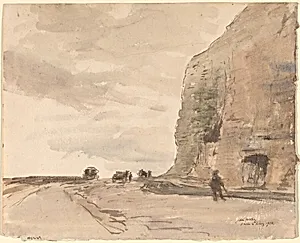
James McBey’s *Dieppe* (1924) invites visitors to the sunlit shores of this historic French coastal town, a favored haunt for artists in the early 20th century. Scottish painter and etcher, known for his landscapes and wartime scenes, captures Dieppe’s bustling harbor and cliffs with a fresh, atmospheric touch. Created during the interwar years, when Europe’s artists embraced travel and leisure after the Great War, this work reflects McBey’s wanderlust—he journeyed widely, sketching en plein air to seize fleeting light and mood. Rendered in watercolor on heavy laid paper, the piece showcases the medium’s fluidity and transparency, ideal for evoking sea breezes and shimmering water. The laid paper’s textured chains and wires add subtle depth, preventing buckling while enhancing the paint’s delicate veining. At just 23.8 x 29.6 cm, its intimate scale draws the eye to intricate details, a hallmark of McBey’s precise yet evocative style influenced by Whistler’s tonalism. Housed in the National Gallery of Art’s Rosenwald Collection, *Dieppe* exemplifies McBey’s versatility beyond etching, bridging British and continental traditions. A gem for admirers of early modernism, it whispers of simpler joys amid a turbulent era.
About the Artist
James McBey · 1883–1959
James McBey (1883–1959) was a Scottish artist renowned for his etchings and paintings, emerging from humble beginnings in Newburgh, Aberdeenshire, as the illegitimate son of a blacksmith's daughter. Largely self-taught, he left school at fifteen to work as a bank clerk in Aberdeen, where he devoured art books from the public library and attended evening classes at Gray's School of Art to hone his ...