
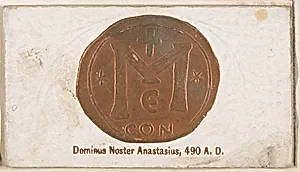
Dominus Noster Anastasius, 490 A.D., from the Ancient Coins series (N180) issued by Wm. S. Kimball & Co.
Medium
Commercial color lithograph
Dimensions
Sheet: 1 1/2 × 2 5/8 in. (3.8 × 6.7 cm)
Classification
Prints|Ephemera
Department
Drawings and Prints
Museum
Metropolitan Museum of Art, New York, NY
Credit
The Jefferson R. Burdick Collection, Gift of Jefferson R. Burdick
Accession Number
63.350.216.180.7
Rights
Public Domain
Tags
Art Historical Context
Step into the world of 19th-century advertising artistry with *Dominus Noster Anastasius, 490 A.D.*, a tiny yet captivating commercial color lithograph from William S. Kimball & Company's *Ancient Coins* series (N180), produced in 1888. This pocket-sized print (just 1 1/2 × 2 5/8 inches) faithfully reproduces an ancient coin depicting Byzantine Emperor Anastasius I, who ruled from 491 to 518 AD. The Latin inscription "Dominus Noster Anastasius" honors him as "Our Lord Anastasius," showcasing the emperor's profile in a style reminiscent of late Roman imperial coinage. Created using chromolithography—a revolutionary color printing technique that allowed for vibrant, mass-produced images— this ephemera was likely issued as a trade card by Kimball's tobacco company. In the Gilded Age, such cards educated and enticed collectors while promoting products, blending classical antiquity with commercial appeal. The precision of the lithography captures fine details like the coin's lettering and imperial portrait, making ancient history accessible to everyday Americans. Today, housed in the Metropolitan Museum of Art's Drawings and Prints department as part of The Jefferson R. Burdick Collection, this piece highlights the intersection of numismatics, printmaking, and consumer culture. It reminds us how ephemera like this preserved cultural heritage amid the ephemerality of advertising.
About the Artist
William S. Kimball & Company · 1850–1950
**William S. Kimball & Company**, a pioneering American tobacco manufacturer, was established in 1846 in Rochester, New York, by William S. Kimball and James C. Hart. The firm quickly grew into one of the city's largest employers, particularly of women, producing popular brands like Peerless chewing tobacco, Rigatta and Fireside smoking tobacco, and Vanity Fair cigarettes. Under Kimball's leadersh...