
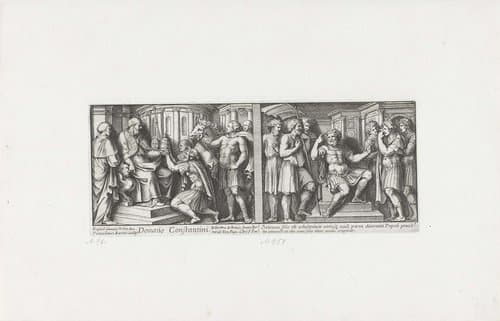
Donatio Constantini / Seleucus filio ob adulterium utriusq oculi paena daninato populi precib
1645 - 1700
Medium
etching
Dimensions
261; 105
Rights
Public Domain
About this artwork
height 105 mm x width 261 mm
Art Historical Context
Pietro Sante Bart, a prominent 17th-century Italianaver from Rome, created this etching between 1645 and 1700. Known for his precise reproductive prints that captured classical antiquities, Renaissance masterpieces, and historical narratives, Bartoli contributed to scholarly publications that popularized art history. This compact work, measuring just 105 mm high by 261 mm wide, the intimate scale of etchings—ideal for books or collectors' albums—allowing detailed scenes to unfold in a panoramic format. The intriguing Latin title, *Donatio Constantini / Seleucus filio ob adulterium utriusq oculi paena daninato populi precib*, evokes dual historical vignettes. The "Donation of Constantine" references the medieval forgery purporting to grant the Pope vast temporal powers, a topic of heated Renaissance debate symbolizing church-state tensions. Paired with it is a dramatic episode involving Seleucus condemning his son to blinding (*utriusque oculi poena*) for adultery, swayed by public outcry—a stark illustration of ancient justice and familial tragedy, possibly drawn from classical texts. As an etching, the piece showcases Bartoli's mastery of acid-bitten lines on a metal plate, yielding fine textures and tonal depth that brought historical drama to life for educated audiences. In the Baroque era, such prints bridged antiquity and contemporary scholarship, inviting viewers to ponder power, punishment, and piety in a single, evocative frame.
About the Artist
Pietro Sante Bartoli · 1615–1700
Pietro Santi Bartoli, born in Perugia in 1635, emerged as a pivotal figure in the Roman antiquarian revival of the late seventeenth century. Relocating to Rome as a youth, he initially pursued painting, studying under the French artist Jean Lemaire—known as "Le Petit Lemaire"—and later under the esteemed Nicolas Poussin, whose classical rigor profoundly shaped his early approach. Though traces of ...