
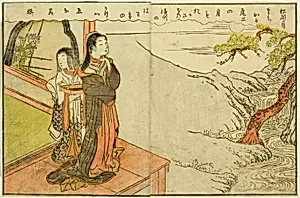
Double-page Illustration from Vol. 2 of "Picture Book of Spring Brocades (Ehon haru no nishiki)"
1771
Medium
Color woodblock print; double-page illustration from book
Dimensions
17.8 × 27 cm (7 × 10 5/8 in.)
Classification
woodblock print
Department
Arts of Asia
Museum
Art Institute of Chicago
Accession Number
34711
Rights
Public Domain
Art Historical Context
Suzuki Harunobu's *Double-page Illustration from Vol. 2 of "Picture Book of Spring Broc (Ehon haru no nishiki)"* (1771) captures the vibrant spirit of Edo-period Japan through a masterful color woodblock print. Harunobu, a pioneeringkiyo-e artist, revolutionized printmaking in 1765 by introducing full *nishiki-e* (brocade pictures), which layered multiple woodblocks for rich, jewel-like hues. This double-page spread from his illustrated book series evokes the fleeting beauty of spring, blending delicate scenes of nature and human life in a format that made art accessible beyond elite circles. The medium's innovation lies in its technical precision: carvers and printers aligned up to 10 blocks per color, achieving subtle gradients and textures on washi paper. Measuring just 17.8 × 27 cm, this intimate page from an *ehon* (picture book) reflects ukiyo-e's focus on the "floating world" of pleasure and ephemera, often featuring elegant courtesans or seasonal motifs. Harunobu's soft, poetic style influenced generations, bridging painting and mass-produced art. Housed in the Art Institute of Chicago's Arts of Asia department, this print highlights Japan's golden age of woodblock printing, where everyday beauty was democratized. Imagine flipping through its pages in 18th-century Tokyo—art for all seasons and senses!
About the Artist
Suzuki Harunobu · 1725–1770
Suzuki Harunobu (c. 1725-1770) was a Japanese ukiyo-e artist who revolutionized woodblock printing by developing nishiki-e—full-color prints using multiple woodblocks—in 1765. Before Harunobu, Japanese prints were limited to two or three colors; his innovation unleashed the entire artist's palette, transforming ukiyo-e into the vibrant art form that would later captivate Western artists from Manet...