
Double-page Illustration from Vol. 1 of "Picture Book of Spring Brocades (Ehon haru no nishiki)"
1771
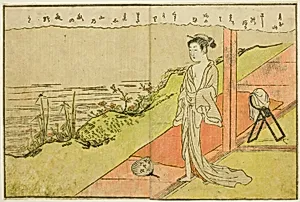
Medium
Color woodblock print; double-page illustration from book
Dimensions
18 × 26.9 cm (7 1/16 × 10 9/16 in.)
Classification
woodblock print
Department
Arts of Asia
Museum
Art Institute of Chicago
Accession Number
34721
Rights
Public Domain
Art Historical Context
Suzuki Harunobu's *Double-page Illustration from Vol 1 of "Picture of Spring BrocadesEhon haru no nishiki)"* (1771) captures the delicate charm of Edo-period Japan through a vibrant color woodblock print. As a pioneering ukiyo artist, Harunobu printmaking in the 1760s by introducing full-color nishiki-e techniques, moving beyond earlier hand-colored or benizuri-e (rose-colored) prints. This double-page spread from his ehon—a luxurious "picture book" format—likely evokes the fleeting beauty of spring, blending poetic imagery with the "floating world" of urban pleasures, courtesans, and nature. Measuring just 18 × 26.9 cm, the intimate scale invites close viewing, showcasing Harunobu's mastery of subtle gradations and layered colors achieved through precise woodblock carving and multiple impressions. Published shortly after his death in 1770, this work exemplifies the ehon tradition, where illustrations took precedence over text, making art accessible yet collectible for Japan's literati and merchants. Housed in the Art Institute of Chicago's Arts of Asia department, it highlights Harunobu's enduring influence on ukiyo-e, inspiring later masters like Utamaro and Hokusai. Visitors will appreciate how such prints preserved seasonal elegance and everyday elegance, offering a window into 18th-century Japanese aesthetics.
About the Artist
Suzuki Harunobu · 1725–1770
Suzuki Harunobu (c. 1725-1770) was a Japanese ukiyo-e artist who revolutionized woodblock printing by developing nishiki-e—full-color prints using multiple woodblocks—in 1765. Before Harunobu, Japanese prints were limited to two or three colors; his innovation unleashed the entire artist's palette, transforming ukiyo-e into the vibrant art form that would later captivate Western artists from Manet...