
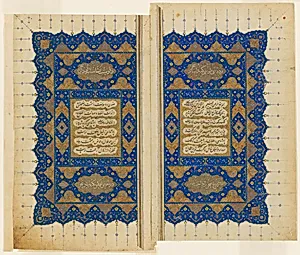
Double Title Page of a copy of the Shahnama of Firdausi
Safavid dynasty (1501–1722), 16th century, c.1550
Medium
Opaque watercolor and gold on paper
Dimensions
28.6 × 34.7 cm (11 1/4 × 13 3/4 in.); Right Page: 29.1 × 17.8 cm (11 7/16 × 7 in.); Left Page: 28.9 × 18.4 cm (11 3/8 × 7 1/4 in.)
Classification
gouache
Department
Arts of Asia
Museum
Art Institute of Chicago
Accession Number
131896
Rights
Public Domain
Art Historical Context
Welcome to the Arts of Asia gallery at the Art Institute of Chicago, where we encounter the exquisite **Double Title Page of a copy of the Shama of Firdausi a gem from the Safavid dynasty1501–1722), dated around 1550. This double-page spread, measuring about 28.6 × 34.7 cm, served as the ornate introduction to a manuscript of Firdausi's epic *Shahnameh* (Book of Kings), the towering Persian national epic recounting Iran's mythical and historical kings from creation to the Islamic conquest. Crafted in opaque watercolor—classified as gouache—and lavish gold on paper, this work exemplifies the pinnacle of Safavid Persian miniature painting. Artists layered vibrant, jewel-like colors with intricate gold illumination to create a luminous, otherworldly effect, evoking the grandeur of royal courts. The technique demanded masterful precision, with fine brushes rendering delicate floral motifs, arabesques, and possibly calligraphic elements that framed the poem's opening verses. Culturally, such title pages were not mere decoration but symbols of imperial patronage, celebrating Persian literary heritage during the Safavid era's artistic renaissance in Tabriz and Shiraz. They invited readers into a world of heroism and legend, blending poetry, history, and artistry in a tradition that influenced Islamic book arts for centuries. Pause here to admire how this page bridges the poetic and the pictorial!
About the Artist
Islamic
Islamic art, a profound visual tradition originating in the 7th century CE, flourished across vast territories from Spain to India under Muslim rule, encompassing architecture, ceramics, manuscripts, textiles, and metalwork produced by diverse artisans rather than a single named master. Drawing from pre-Islamic Sasanian, Byzantine, and late antique influences, its early development under the Umayy...