
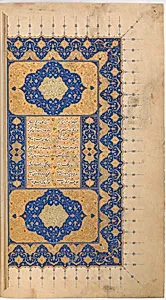
Khamsa (Quintet) of Nizami of Ganja
1509–10
Medium
Leather; tooled and gilded; ink on paper
Dimensions
H. 11 1/2 (29.2 cm) W. 7 in. (17.8 cm)
Classification
Codices
Department
Islamic Art
Museum
Metropolitan Museum of Art, New York, NY
Credit
Gift of Alexander Smith Cochran, 1913
Accession Number
13.228.6
Rights
Public Domain
Tags
Art Historical Context
Welcome to the Islamic Art galleries at the Metropolitan Museum of Art where we showcase treasures like the *Khamsa (Quintet) of Nizami of Ganja* (1509–10). This exquisite cod captures the poetic genius ofizami, the 12th-century Persian master whose five epic poems—exploring love, heroism, and mysticism—formed one of the greatest works in classical Persian literature. Produced over three centuries later, this reflects the enduring reverence for Nizami's in the Safavid era a golden age for Persian arts. Crafted with ink on paper and housed in a finely tooled and gilded leather binding, the book measures a portable 11½ x 7 inches, ideal for intimate study or royal libraries. Its classification as a codex highlights the pinnacle of Islamic book arts, where calligraphy intertwined with illumination to bring vivid scenes to life—think dynamic depictions of men and horses charging through romantic and epic narratives, evoking chivalric adventures from stories like *Khosrow and Shirin* or *Layla and Majnun*. A generous gift from Alexander Smith Cochran in 1913, this *Khamsa* exemplifies cultural synthesis: Persian poetry visualized through intricate techniques, bridging literature and visual splendor. Pause here to imagine courtiers poring over its pages, lost in Nizami's timeless worlds.