
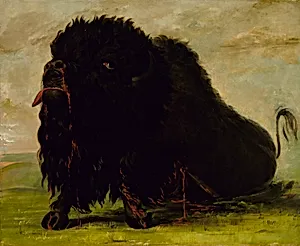
Dying Buffalo, Shot with an Arrow
1832-1833
Medium
Painting
Classification
Painting
Department
Smithsonian Collection
Museum
Smithsonian American Art Museum
Credit
Smithsonian American Art Museum, Gift of Mrs. Joseph Harrison, Jr.
Accession Number
1985.66.407
Rights
Public Domain
Tags
About this artwork
“The American bison, or . . . buffalo, is the largest of the ruminating animals that is now living in America; and seems to have been spread over the plains of this vast country, by the Great Spirit, for the use and subsistence of the red men, who live almost exclusively on their flesh, and clothe themselves with their skins . . . The buffalo bull often grows to the enormous weight of 2000 pounds, and shakes a long and shaggy black mane, that falls in great profusion and confusion over his head ...
Art Historical Context
George Catlin's *Dying Buffalo, Shot an Arrow* (1832–1833) captures a poignant moment from his expeditions along the Upper Missouri River, where he sketched this scene amid the vast Plains. As a pioneering artist and ethnographer, Catlin dedicated his career to documenting Native American life and the American West before rapid settlement transformed it. This painting reflects his firsthand observations of buffalo hunts, central to Indigenous sustenance and culture, as he himself noted: the bison, weighing up to 2,000 pounds with its shaggy black mane and arched horns, was "spread over the plains... for the use and subsistence of the red men." Rendered in oil, the work showcases Catlin's realistic style, emphasizing anatomical accuracy and dramatic tension—the wounded buffalo's struggle evokes both the raw power of nature and the skill of the hunter. Its cultural significance lies in highlighting the buffalo's vital role in Plains tribes' survival, from food to clothing, at a time when these herds faced decline. Today, housed in the Smithsonian American Art Museum (gift of Mrs. Joseph Harrison, Jr.), this piece invites visitors to reflect on America's frontier heritage and the urgent preservation Catlin championed.
About the Artist
George Catlin · 1796–1872
George Catlin (1796–1872), born in Wilkes-Barre, Pennsylvania, to Putnam Catlin and Polly Sutton—who had been captured by Native Americans during the 1778 Battle of Wyoming—initially pursued a legal career. Trained at Litchfield Law School, he was admitted to the bar in 1819 but abandoned law after two years to study art in Philadelphia in 1823. Self-taught as a portraitist, Catlin quickly gained ...