
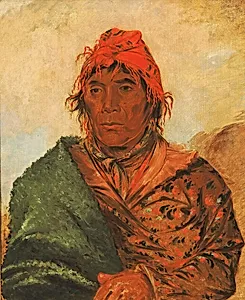
Ee-mat-lá-, King Phillip, Second Chief
1838
Medium
Painting
Classification
Painting
Department
Smithsonian Collection
Museum
Smithsonian American Art Museum
Credit
Smithsonian American Art Museum, Gift of Mrs. Joseph Harrison, Jr.
Accession Number
1985.66.302
Rights
Public Domain
Tags
About this artwork
George Catlin painted Seminole chief King Phillip at Fort Moultrie, near Charleston, South Carolina, in January 1838. Catlin described him as a “very aged chief, who has been a man of great notoriety and distinction in his time.” (Catlin, Letters and Notes, vol. 2, no. 57, 1841; reprint 1973)
Art Historical Context
In 1838, renowned artist George Catlin captured dignified likeness of Ee-mat-lá, known as King Phillip, the second chief of the Seminole, in this striking oil portrait. Painted at Fort Moultrie near Charleston, South Carolina, the work depicts the elderly leader during a turbulent era. Catlin himself noted in his *Letters and Notes* that Phillip was "a very chief, who has been a man of greatiety and distinction in his," highlighting his stature amid the Second Seminole War1835–1842), when the Seminoles fiercely resisted U.S. forced removal from Florida. Catlin, a pioneering 19th-century painter dedicated to documenting Native American cultures, created this as part of his ambitious portfolio of over 600 portraits. His realistic style—emphasizing facial details, traditional attire, and expressive gazes—served as both artistic achievement and ethnographic record, preserving vanishing traditions before widespread displacement. Housed in the Smithsonian American Art Museum, this painting offers a poignant window into Seminole resilience and leadership. Today, it reminds visitors of the human stories behind historical conflicts, celebrating King Phillip's legacy through Catlin's empathetic brushwork. (198 words)
About the Artist
George Catlin · 1796–1872
George Catlin (1796–1872), born in Wilkes-Barre, Pennsylvania, to Putnam Catlin and Polly Sutton—who had been captured by Native Americans during the 1778 Battle of Wyoming—initially pursued a legal career. Trained at Litchfield Law School, he was admitted to the bar in 1819 but abandoned law after two years to study art in Philadelphia in 1823. Self-taught as a portraitist, Catlin quickly gained ...