
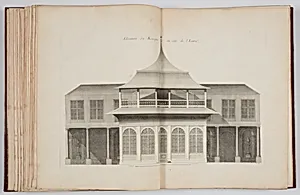
Elévation du Kiosque du côté de l'Entrée.
Medium
Bound print
Classification
Bound print
Department
Smithsonian Collection
Museum
Smithsonian American Art Museum
Credit
Purchased for the Museum by the Advisory Council
Accession Number
1921-6-209-19
Rights
Public Domain
About this artwork
Research in Progress
Art Historical Context
**Élivation du Kiosque du côté de l'Entrée** *Emmanuel Héré deny, French, 1705–1763, 1753* Bound print; Smithsonian American Art Museum in 1753 by French architect Emmanuel Héré deny, this bound print captures the elegant "elevation"—a precise side view—of a kiosk at an entrance, likely part of a grand architectural ensemble. Héré, renowned for his urban planning in Nancy, France, where he served as chief architect to King Stanisław Leszczyński Duke of Lorraine, blended French neoclassical precision with ornamental flair. His designs, including the UNESCO-listed Place Stanislas, emphasized harmony, symmetry, and public splendor during the Enlightenment era, when architecture celebrated reason and monarchy. As a bound print, this work exemplifies 18th-century techniques for disseminating architectural ideas. Etched or engraved for clarity and detail, such prints were often compiled in folios for study by builders, patrons, and scholars, bridging design conception and execution. Though research on this specific piece continues, it reflects Héré's commitment to functional beauty—kiosks serving as ornate gateways or pavilions in royal gardens and civic spaces. Visitors, imagine strolling Nancy's luminous squares: this print invites you to appreciate the enduring legacy of Rococo-inflected classicism in everyday grandeur. (198 words)