
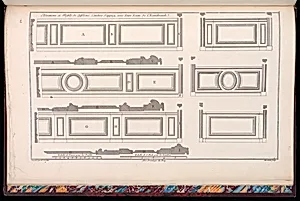
Elévations et Profils de différens Lambris d’appuy, avec leurs bouts de Chambranle
Medium
Classification
Department
Smithsonian Collection
Museum
Smithsonian American Art Museum
Credit
Purchased for the Museum by the Advisory Council
Accession Number
1921-6-274-48
Rights
Public Domain
About this artwork
Research in Progress
Art Historical Context
This print by F. Cornille, produced between 1751 and 1755, captures detailed elevations and profiles of various lambris d’appui—ornamental wall paneling typically used as dados or wainscoting—along with their connecting chambranle elements that framed doors and windows. As a skilled printmaker active in the 1740s and 1750s, Cornille created this work during a flourishing period of French decorative arts, when such plates served as practical yet artistic references for architects and craftsmen. Prints like this one played a vital role in 18th-century Europe by circulating sophisticated interior designs far beyond their origins. They allowed builders and patrons to select and adapt elegant woodwork that blended functionality with refined ornament, transforming rooms into harmonious, light-filled spaces typical of the era. The medium of printmaking, with its precise lines and scalable details, made these ideas accessible and reproducible, helping to shape tastes in architecture and furniture across continents. Acquired for the Smithsonian American Art Museum by the Advisory Council, this piece invites viewers to appreciate both its technical accuracy and its glimpse into historical interiors. It stands as a testament to how printed designs preserved and inspired the artistry of everyday luxury in the mid-18th century.