
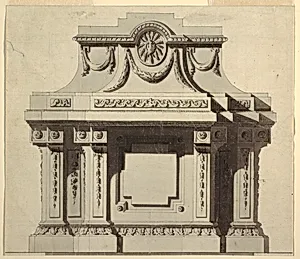
Elevation of a Wall Monument
Classification
architecture
Department
Smithsonian Collection
Museum
Smithsonian American Art Museum
Credit
Purchased for the Museum by the Advisory Council
Accession Number
1911-28-303
Rights
Public Domain
About this artwork
Research in Progress
Art Historical Context
**Elevation of a Wall Monument** Jean-Charles Delafosse (1734–1789), a prominent French architect and engraver, created this *Elevation of a Wall Monument* 1780. Working during the late Louis XVI period, Delafosse bridged Rococo exuberance and emerging Neoclassicism, producing influential designs for furniture, interiors, and architecture. His pattern books popularized elegant, symmetrical motifs inspired by antiquity, reflecting Enlightenment ideals of order and harmony. Acquired by the Smithsonian American Art Museum through its Advisory Council, this work highlights transatlantic exchanges in design during the era. As an architectural elevation—a precise, two-dimensional rendering of a structure's facade—this piece depicts a wall-mounted monument, likely intended for commemorative or funerary purposes. Such designs were essential for monumental architecture, allowing builders to visualize grandeur in stone or marble against a wall surface. Delafosse's meticulous style would emphasize refined proportions, classical columns, and sculpted details, embodying the refined taste of French aristocracy on the eve of the Revolution. Though research continues, this drawing offers a window into 18th-century European design practices, underscoring how ornamental architecture shaped public memory and prestige. Visitors can appreciate its role in the evolution of neoclassical aesthetics that later influenced American builders.