
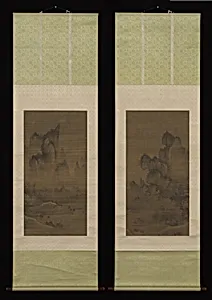
해질녘 산사의 종소리 조선|煙寺暮鍾圖 朝鮮|Evening bell from mist-shrouded temple (left); Autumn moon over Lake Dongting (right)
ca. 1450–1500
Medium
Pair of hanging scrolls; ink on silk
Dimensions
Image (each): 35 3/8 x 17 7/8 in. (89.9 x 45.4 cm) Overall with mounting (each): 78 1/4 x 24 in. (198.8 x 61 cm) Overall with knobs (each): 78 1/4 x 27 7/8 in. (198.8 x 70.8 cm)
Classification
Paintings
Culture & Period
Korea · Joseon dynasty (1392–1910)
Department
Asian Art
Museum
Metropolitan Museum of Art, New York, NY
Credit
Purchase, Joseph Pulitzer Bequest, and Mr. and Mrs. Frederick P. Rose and John B. Elliott Gifts, 1987
Accession Number
1987.278a, b
Rights
Public Domain
Tags
Art Historical Context
This exquisite pair of hanging by the Joseon dynasty artist An Gyeonactive ca. 1440–1470) dates to around 1450–1500 and exemplifies the refined ink landscape tradition of Korea. Rendered in delicate ink washes on silk, each scroll measures about 35 x18 inches, designed for vertical display in scholarly rooms or palaces. Hanging scrolls like these were prized for their portability and ability to evoke poetic contemplation, unrolling to reveal misty mountains and serene waters that transport viewers to an idealized natural world. The left scroll depicts the "Evening Bell from a Mist-Shrouded Temple" (Yansa钟소리), where swirling mists envelop craggy peaks and a distant monastery, the faint bell toll suggesting spiritual harmony amid twilight solitude. Paired with it on the right is "Autumn Moon over Lake Dongting," capturing the luminous moon reflected on China's famed lake, surrounded by layered hills. These motifs draw from the classic Chinese "Eight Views of the Xiao-Xiang" series, adapted in Korean art to express Confucian ideals of quietude and the sublime beauty of nature. An Gyeon's masterful use of ink gradations creates atmospheric depth, blending realism with subtle lyricism—a hallmark of early Joseon painting. Acquired by the Metropolitan Museum of Art in 1987, these scrolls offer a window into 15th-century Korea's cultural reverence for landscapes as metaphors for inner peace.