
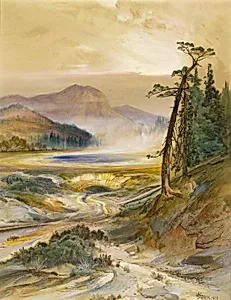
Excelsior Geyser, Yellowstone Park
1873
Medium
Painting
Classification
Painting
Department
Smithsonian Collection
Museum
Smithsonian American Art Museum
Credit
Smithsonian American Art Museum, Gift of Mrs. Armistead Peter III
Accession Number
1958.5.1
Rights
Public Domain
Tags
Art Historical Context
Thomas Moran's *Excelsior Geyser, Yellowstone Park* (1873) captures the raw majesty of one of America's most iconic natural wonders. As a leading figure in the Hudson River School, Moran was renowned for his luminous, romantic landscapes that celebrated the sublime beauty of the American West. This oil painting, now housed in the Smithsonian American Art Museum (gift of Mrs. Armistead Peter III), depicts the steaming Excelsior Geyser in Yellowstone National Park, Wyoming, surrounded by rugged mountains, the winding Yellowstone River, and resilient pine trees. Moran's work emerged from his participation in Ferdinand Hayden's 1871 geological survey expedition, where he sketched Yellowstone's geothermal spectacles firsthand. His vibrant watercolors and subsequent oil paintings, like this one, vividly conveyed the area's otherworldly drama—boiling pools, erupting geysers, and misty vapors—using loose brushwork and glowing light effects to evoke nature's untamed power. Historically significant, Moran's Yellowstone imagery played a pivotal role in persuading Congress to establish the world's first national park in 1872, preserving its treasures for future generations. For visitors, this painting isn't just art; it's a window into the birth of American conservation, inviting awe at the enduring allure of the wild West.
About the Artist
Thomas Moran · 1837–1926
Thomas Moran (1837–1926) was an American painter and printmaker of the Hudson River School whose dramatic paintings of the American West played a pivotal role in the creation of the national parks. Born in Bolton, Lancashire, England, he emigrated with his family to Philadelphia as a child. He was largely self-taught, though he apprenticed briefly with a wood engraver and studied the work of J.M.W...