
Facsimile painting from the temple of Thutmose III
ca. 1479–1458 B.C.
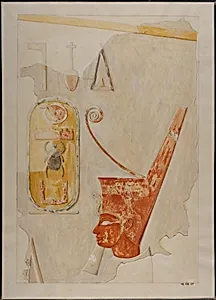
Medium
Tempera on paper
Dimensions
facsimile: h. 41.7 cm (16 7/16 in); w. 28.4 cm (11 3/16 in), scale 1:1, framed: h. 47.9 cm (18 7/8 in); w. 34.9 cm (13 3/4 in)
Classification
Facsimile, Thutmose III
Period
New Kingdom
Department
Egyptian Art
Museum
Metropolitan Museum of Art, New York, NY
Credit
Rogers Fund, 1948
Accession Number
48.105.27
Rights
Public Domain
Art Historical Context
This facsimile captures a vibrant detail from the temple of Pharaoh Thutmose III, one of ancient Egypt’s most celebrated rulers during Dynasty 18 of the New Kingdom. Created by Charles K. Wilkinson in tempera on paper at actual size, the work reproduces wall paintings that once adorned sacred spaces built to honor the king’s military achievements and divine kingship. Such facsimiles preserve the brilliant colors and precise line work of the originals, many of which have faded or suffered damage over millennia. Wilkinson’s careful technique reflects both the artistic conventions of ancient Egyptian painters—bold outlines, symbolic poses, and harmonious proportions—and the scholarly mission of early twentieth-century Egyptologists. By recording these images at a 1:1 scale, he provided modern viewers with an immediate sense of how temple walls would have appeared when freshly painted, transforming ephemeral architectural decoration into a portable museum object. Acquired by the Metropolitan Museum in 1948, the facsimile now serves as an accessible bridge between the grandeur of Thutmose III’s monuments and today’s visitors, allowing close study of Egypt’s enduring artistic legacy without traveling to the original temple sites.
About the Artist
Charles K. Wilkinson · 1897–1986
Charles K. Wilkinson (1897–1986), born Charles Kyrle Wilkinson in London on October 13, 1897, was the son of Horace W. Wilkinson, a stained-glass window maker, and Frances Adkins. Serving in World War I, he honed his artistic skills at the Slade School of Fine Art, University College London, where the influential director Henry Tonks shaped the rigorous training of a generation of draughtsmen. In ...