
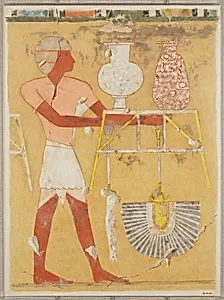
Man Bringing New Year's Gifts
A.D. 1914–1916; original ca. 1427–1400 B.C.
Medium
Tempera on paper
Dimensions
facsimile: h. 53 cm ( 20 7/8 in); w. 39 cm ( 15 3/8 in), scale 2:9; framed: h. 56.5 cm (22 1/4 in); w. 42.5 cm (16 3/4 in)
Classification
Facsimile, Qenamun (TT 93), offering bearer, man; Drink-and-be-Merry
Period
Twentieth Century; original New Kingdom
Department
Egyptian Art
Museum
Metropolitan Museum of Art, New York, NY
Credit
Rogers Fund, 1930
Accession Number
30.4.66
Rights
Public Domain
Tags
Art Historical Context
Behold *Man Bringing New Year's Gifts*, a vibrant created by Hugh R.good between 1914 and 1916. This tempera-on-paper reproduction captures an original ancient Egyptian scene from the New Kingdom's Dynasty 18, dating to around 1427–1400 B.C.—a golden age of pharaonic power under rulers like Amenhotep III Measuring about 53 cm high and 39 cm wide at a 2:3 scale, it evokes the festive spirit of Egyptian New Year celebrations, likely tied to the Nile's life-giving floods, with tags hinting at merry men enjoying drinks and gifts. The original artwork reflects the Egyptians' love for joyful, communal rituals, where offerings symbolized renewal and abundance. Such scenes, often from tombs or temple walls, used vivid colors and stylized figures to ensure prosperity in the afterlife. Hopgood's meticulous tempera technique—layering pigments with egg binder—brilliantly mimics the flat, eternal quality of ancient Egyptian painting, preserving details like flowing garments and expressive poses for modern eyes. Acquired via the Rogers Fund in 1930, this piece in the Metropolitan Museum of Art's Egyptian Art department bridges millennia, inviting us to toast ancient merriment. It reminds visitors how Egyptians blended daily revelry with cosmic cycles, their art a timeless "drink and be merry" hymn.