
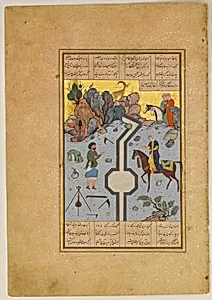
"Farhad Carves a Milk Channel for Shirin", Folio 74 from a Khamsa (Quintet) of Nizami of Ganja
A.H. 931/1524–25 CE
Medium
Ink, opaque watercolor, and gold on paper
Dimensions
Painting: H. 8 3/8 in. (21.3 cm) W. 5 1/16 in. (12.9 cm) Page: H. 12 5/8 in. (32.1 cm) W. 8 3/4 in. (22.2 cm) Mat: H. 19 1/4 in. (48.9 cm) W. 14 1/4 in. (36.2 cm)
Classification
Codices
Department
Islamic Art
Museum
Metropolitan Museum of Art, New York, NY
Credit
Gift of Alexander Smith Cochran, 1913
Accession Number
13.228.7.5
Rights
Public Domain
Tags
Art Historical Context
This exquisite folio from a 1524–25 Safavid manuscript of Nizami’s Khamsa captures a beloved scene from the Persian romance of Khosrow and Shirin. In the tale, the devoted sculptor Farhad carves a miraculous channel through the mountains so that milk from Shirin’s goats can flow directly to her castle—an act of love and ingenuity. Created during the reign of Shah Tahmasp, the painting reflects the refined court culture of early sixteenth-century Iran, where poetry, storytelling, and visual art intertwined to celebrate heroic and romantic ideals. The work is attributed to several artists, including Sultan Muhammad Nur, Mahmud Muzahib, and Shaikh Zada, who contributed to the manuscript’s illumination and illustration. Executed in ink, opaque watercolor, and gold on paper, the miniature exemplifies the delicate techniques of Persian painting: fine brushwork, vibrant mineral pigments, and luminous gold accents that bring depth and richness to the landscape and figures. The inclusion of horses, goats, and elegantly dressed men and women situates the narrative within a lively pastoral setting. As part of a complete Khamsa codex now in the Metropolitan Museum’s Islamic Art collection, this folio highlights the manuscript’s role as both a literary treasure and a work of art meant for intimate viewing by courtly audiences. Its survival offers modern visitors a vivid window into the storytelling traditions and artistic mastery of Safavid Persia.