
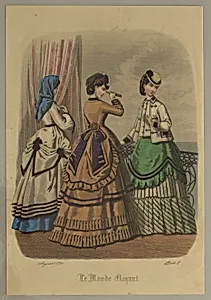
Fashion Plate from Le Monde Elégant
1870
Classification
Department
Smithsonian Collection
Museum
Smithsonian American Art Museum
Credit
Gift of Hamill and Barker
Accession Number
1962-143-19
Rights
Public Domain
About this artwork
Research in Progress
Art Historical Context
Step into the elegant world of 19th-century Paris with this *Fashion Plate from Le Mondeégant* (1870), a print preserved in the Smithsonian American Art's collection. Fashion plates like this one were the Instagram of their era—vibrant illustrations showcasing the latest trends for the fashionable elite. Published in the renowned French magazine *Le Mondeégant*, which debuted in 1838, these prints captured the opulent styles of the Second Empire, lithography or engraving with hand-coloring to bring haute couture to life on paper. Created amid the turbulent year of 1870, just before the fall of Napoleon III and the Franco-Prussian War, this plate reflects a pivotal moment in fashion history. Women's silhouettes featured voluminous skirts supported by crinolines or emerging bustles, intricate lace trims, and luxurious fabrics like silk and velvet, symbolizing social status and refinement. As a print, it democratized high fashion, allowing middle-class readers worldwide—including in America—to emulate Parisian chic through copied patterns and aspirations. Generously gifted by Hamill and Barker to the Smithsonian, this artwork highlights the cultural exchange between Europe and the U.S. Though research continues, it stands as a window into how visual culture shaped identity, consumerism, and glamour in a rapidly modernizing world. A delightful glimpse of bygone sophistication!
About the Artist
Unknown
The artist designated as "Unknown" in our virtual museum's collection exemplifies a poignant chapter in art history: creators whose identities have faded into obscurity despite the enduring power of their work. With only one known artwork attributed to them in our holdings, this figure represents countless anonymous hands that shaped visual culture across centuries. Museums worldwide, including th...