
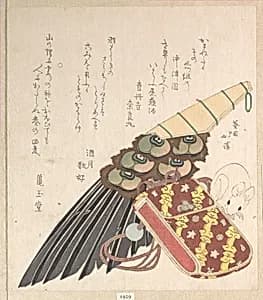
Feather-Brush and Doran (a Kind of Medicine Case) with a Netsuke of a Rat
probably 1816
Medium
Woodblock print (surimono); ink and color on paper
Dimensions
8 3/8 x 7 1/4 in. (21.3 x 18.4 cm)
Classification
Prints
Culture & Period
Japan · Edo period (1615–1868)
Department
Asian Art
Museum
Metropolitan Museum of Art, New York, NY
Credit
H. O. Havemeyer Collection, Bequest of Mrs. H. O. Havemeyer, 1929
Accession Number
JP1929
Rights
Public Domain
Tags
Art Historical Context
This delightful woodblock print, titled *Feather-Brush and Dor (a Kind of Medicine) with a Netsuke a Rat*, was created by Totoya Hokkei around 1816 during Japan's Edo period (1615–1868). Hokkei, a skilled ukiyo-e artist pupil of the famed Katsushika Hokusai, specialized in surimono—luxurious, privately commissioned prints often produced for New Year's greetings or special occasions. with vibrant inks and colors on paper, this intimate work measures just 8 3/8 x 7 1/4 inches, perfect for personal appreciation. The composition playfully captures everyday objects with meticulous detail: a feather-brush for calligraphy, a doran (a traditional lacquered medicine case), and a carved netsuke of a rat perched nearby. Netsuke, these tiny toggles secured inro cases to kimono sashes, were prized for their whimsical carvings and functionality. The rat, evoking the Chinese zodiac's first animal symbolizing wit and prosperity, adds a touch of folklore charm amid the textures of feathers and lacquer. As part of the Metropolitan Museum of Art's H. O. Havemeyer Collection, this surimono exemplifies Edo-era craftsmanship, where advanced woodblock techniques like precise color registration brought humble items to life. It invites us to marvel at Japan's blend of utility, artistry, and subtle humor.
About the Artist
Totoya Hokkei · 1780–1850
Totoya Hokkei (魚屋 北渓, 1780–1850), born Iwakubo Tatsuyuki in Edo (modern Tokyo), began his life as a humble fishmonger in the Yotsuya Samegahashi district, a trade reflected in his art name "Totoya," meaning fish shop. He transitioned to art through rigorous training, first studying under Kanō Yōsen'in Korenobu, head of the Kobikichō branch of the prestigious Kanō school, where he honed landscape p...