
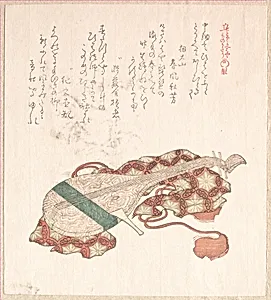
Biwa (Japanese Lute) with Cover
19th century
Medium
Woodblock print (surimono); ink and color on paper
Dimensions
8 x 7 3/16 in. (20.3 x 18.3 cm)
Classification
Prints
Culture & Period
Japan · Edo period (1615–1868)
Department
Asian Art
Museum
Metropolitan Museum of Art, New York, NY
Credit
H. O. Havemeyer Collection, Bequest of Mrs. H. O. Havemeyer, 1929
Accession Number
JP1983
Rights
Public Domain
Tags
Art Historical Context
This exquisite woodblock print, *Biwa (Japanese Lute) with Cover*, crafted by Kubo Shunman the 19th century Japan's Edo period (1615–1868), captures the refined elegance of a traditional biwa—a four-stringed lute central to Japanese musical storytelling. Shunman, a versatile ukiyo-e artist for his poetic imagery and mastery of surimono, created this intimate work (just 8 x 7 3/16 inches) as a privately commissioned print, often exchanged among literati during New Year's celebrations. Surimono, meaning "printed things," elevated woodblock printing to an art form rivaling painting, using vibrant inks, subtle colors, and sometimes metallic accents on fine paper for a luxurious tactile quality. Here, Shunman's precise lines and harmonious composition highlight the biwa's pear-shaped body and protective cover, evoking the instrument's role in narrating epic tales like *The Tale of the Heike*. Part of the Metropolitan Museum of Art's H. O. Havemeyer Collection, it reflects Edo Japan's thriving print culture, where everyday objects became symbols of cultural heritage. Visitors will appreciate how this small gem bridges music, poetry, and craftsmanship, offering a window into the sophisticated tastes of 19th-century Japan.
About the Artist
Kubo Shunman · 1757–1820
Japanese, 1757–1820