
Female skeleton playing the guitar (vignette for the feast of the dead)
ca. 1890–1910
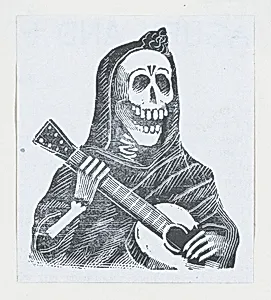
Medium
Type-metal engraving (photomechanical reproduction?, letterpress on verso)
Dimensions
Sheet: 2 3/4 × 2 3/8 in. (7 × 6 cm)
Classification
Prints
Department
Drawings and Prints
Museum
Metropolitan Museum of Art, New York, NY
Credit
Gift of Jean Charlot, 1930
Accession Number
30.82.5
Rights
Public Domain
Tags
Art Historical Context
In the whimsical yet macabre world of José Guadalupe Posada, this tiny vignette titled *Female Skeleton Playing the Guitar (Vignette for the Feast the Dead)* captures the artist's signature flair for *calaveras*—skeletal figures engaged in everyday joys. Created around 1890–1910, the print depicts a grinning female skeleton strumming a guitar, ev Mexico's Día de los Muertos celebrations where death is danced with rather than feared. Posada, a pioneering Mexican printmaker, used these images in satirical broadsheets to poke fun at social hierarchies, reminding viewers that death levels all. Rendered in type-metal engraving—likely a photomechanical reproduction with letterpress on the verso—this 2¾ × 2⅜-inch sheet was designed as a vignette for newspapers or festive ephemera. Its modest scale belies its cultural punch: Posada's bold lines and exaggerated forms popularized folk art motifs, influencing later Mexican graphic traditions and even Diego Rivera's murals. Donated to the Metropolitan Museum of Art in 1930 by Jean Charlot, it exemplifies how Posada democratized art through affordable prints, blending indigenous reverence for ancestors with biting commentary on mortality. Today, this guitar-strumming calavera invites us to reflect on life's fleeting melody, a timeless emblem of Mexico's vibrant dance with death.
About the Artist
José Guadalupe Posada · 1852–1913
José Guadalupe Posada (1852-1913) was a Mexican printmaker and engraver who revolutionized popular art and created some of the most iconic images in Mexican culture. Working primarily with publisher Antonio Vanegas Arroyo, he produced over 20,000 images during his career—inexpensive broadsheets sold for a penny on colored paper that made his art accessible to even the poorest workers. He transform...