
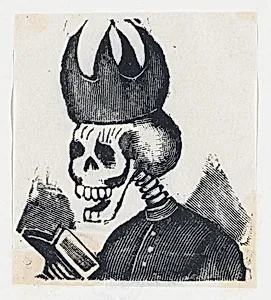
A skeleton wearing a bishop's mitre reading a book (vignette for the feast of the dead)
ca. 1890–1910
Medium
Type-metal engraving
Dimensions
Sheet: 2 9/16 × 2 3/8 in. (6.5 × 6 cm)
Classification
Prints
Department
Drawings and Prints
Museum
Metropolitan Museum of Art, New York, NY
Credit
Gift of Jean Charlot, 1930
Accession Number
30.82.2
Rights
Public Domain
Tags
Art Historical Context
In the whimsical yet macabre world of José Guadalupe Posada, Mexican printmaker extraordinaire (1852–1913), this tiny vignette titled *A Skeleton Wearing a Bishop's Mit Reading a Book* captures the artist's signature flair for *calaveras*—skeletal figures that poke fun at death's inevitability. Created around 1890–1910, the image shows a bony cleric, adorned with a towering bishop's hat, intently absorbed in a book amid the Feast of the Dead celebrations. Posada, a master of satirical illustration for Mexico City's newspapers and broadsheets, used these grinning skeletons to lampoon society, blending humor with social commentary during the turbulent Porfiriato era. This type-metal engraving, a relief printing technique using metal type blocks for quick, affordable reproduction, measures just 2 9/16 × 2 3/8 inches—perfect for vignettes in popular almanacs or *calaveritas literarias* (humorous epitaphs). It reflects Mexico's Día de Muertos traditions, where death is not feared but festively embraced, equalizing all in skeletal form, from peasants to prelates. Posada's bold black lines and stark contrasts influenced generations, including Diego Rivera, cementing his role in shaping Mexico's graphic arts legacy. Today, this gift to the Metropolitan Museum of Art in 1930 invites visitors to chuckle at mortality's irony: even a pious bishop can't escape the great leveler, book in bony hand.
About the Artist
José Guadalupe Posada · 1852–1913
José Guadalupe Posada (1852-1913) was a Mexican printmaker and engraver who revolutionized popular art and created some of the most iconic images in Mexican culture. Working primarily with publisher Antonio Vanegas Arroyo, he produced over 20,000 images during his career—inexpensive broadsheets sold for a penny on colored paper that made his art accessible to even the poorest workers. He transform...