
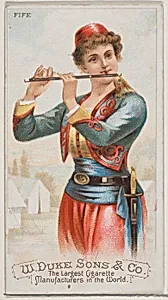
Fife, from the Musical Instruments series (N82) for Duke brand cigarettes
Medium
Commercial color lithograph
Dimensions
Sheet: 2 3/4 x 1 1/2 in. (7 x 3.8 cm)
Classification
Prints|Ephemera
Department
Drawings and Prints
Museum
Metropolitan Museum of Art, New York, NY
Credit
The Jefferson R. Burdick Collection, Gift of Jefferson R. Burdick
Accession Number
63.350.204.82.19
Rights
Public Domain
Tags
Art Historical Context
Step into the vibrant world of 19th-century advertising with *Fife, from the Musical Instruments series (N82)*, a diminutive yet delightful commercial color lithograph produced in 1888 by W. Duke, Sons & Co. in collaboration with Schumacher & Ettlinger. Measuring just 2 3/4 x 1 1/2 inches, this ephemera was designed as a collectible trade card inserted into Duke brand cigarette packs, enticing smokers with colorful imagery of musical instruments like the fife—a small, high-pitched flute favored in military and folk traditions. Chromolithography, the era's cutting-edge printing technique, allowed for the card's vivid hues and precise details, transforming everyday tobacco products into coveted collectibles. Duke's innovative series tapped into the growing hobby of card collecting, helping the company dominate the American cigarette market amid fierce competition. The tags hint at a female musician, reflecting subtle shifts in cultural depictions of women engaging with music during the Gilded Age. Today, this gem resides in the Metropolitan Museum of Art's Drawings and Prints department, part of The Jefferson R. Burdick Collection. It offers a window into how commerce intertwined with popular culture, blending artistry with consumerism in an age before digital media.
About the Artist
W. Duke, Sons & Co.|Schumacher & Ettlinger · 1870–1920
**W. Duke, Sons & Co.: Pioneers of Chromolithographic Trade Card Art** W. Duke, Sons & Co., an American tobacco manufacturer, emerged from the entrepreneurial vision of Washington Duke (1820–1905) and his sons in Durham, North Carolina. After the Civil War, Washington abandoned farming in 1874 to join his eldest son, Brodie L. Duke, in the burgeoning tobacco trade, establishing a factory that for...