
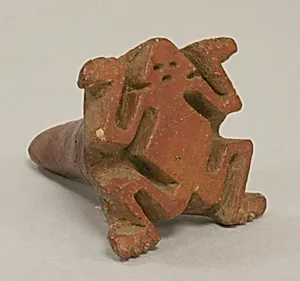
Figure Stamp
Unknown Artist
1st–7th century
Medium
Ceramic
Dimensions
H. 1 7/16 x W. 2 1/8 x D. 1 1/2 in. (3.7 x 5.4 x 3.8 cm)
Classification
Ceramics-Implements
Culture
Atlantic Watershed
Department
Arts of Africa, Oceania, and the Americas
Museum
Metropolitan Museum of Art, New York, NY
Credit
The Michael C. Rockefeller Memorial Collection, Bequest of Nelson A. Rockefeller, 1979
Accession Number
1979.206.1181
Rights
Public Domain
Tags
Art Historical Context
This petite ceramic *Figure Stamp* from the Watershed culture of ancient Colombia, dating to the 1–7th century CE exemplifies the ingenuity of pre-Columbian artisans. Carved in clay and measuring just under 2 inches wide, it features a stylized human figure, likely intended as a stamp for imprinting patterns on skin, textiles, or other soft surfaces during rituals or daily life. Its compact size made it highly portable, a testament to the practical artistry of the period. In the Atlantic Watershed region—spanning northern Colombia's river valleys—these stamps were part of a vibrant ceramic tradition, blending functionality with symbolic expression. Artisans hand-modeled the figures with simple, expressive forms, capturing human anatomy in abstracted poses that hint at cultural beliefs in ancestry, fertility, or spiritual intermediaries. Such implements reveal how everyday objects doubled as cultural touchstones, bridging the mundane and the sacred. Now housed in The Metropolitan Museum of Art's Michael C. Rockefeller Memorial Collection, this stamp offers a window into a little-known society predating European contact. Its survival underscores the durability of ceramic as a medium, preserving echoes of ancient lives for modern visitors.