
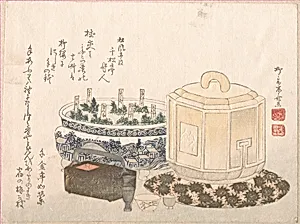
Fire-Holder and Flower-Pot
19th century
Medium
Woodblock print (surimono); ink and color on paper
Dimensions
5 5/8 x 7 1/2 in. (14.3 x 19.1 cm)
Classification
Prints
Culture & Period
Japan · Edo period (1615–1868)
Department
Asian Art
Museum
Metropolitan Museum of Art, New York, NY
Credit
H. O. Havemeyer Collection, Bequest of Mrs. H. O. Havemeyer, 1929
Accession Number
JP2002
Rights
Public Domain
Art Historical Context
Nestled in the Metropolitan Museum of Art's Asian Art collection, *Fire-Holder and Flowerot* is a delicate 19th-century woodblock by Ryūryūkyo Shinsai, a master of the ukiyo-e tradition during Japan's Edo period (16151868). Measuring just 5⅝ × 7½ inches, this intimate surimono— a, privately commissioned print—captures everyday objects with poetic elegance. Shinsai, known his refined depictions of nature and domestic scenes, renders the fire-holder (likely a hibachi warmer) and flower-pot in vibrant inks and colors on paper, evoking the serene beauty of transient moments. Surimono like this one were elite commissions, often for poetry gatherings or New Year's greetings, featuring embossed textures, metallic pigments, and subtle gradients (bokashi) that showcase the woodblock printer's artistry. Unlike mass-produced ukiyo-e, their small scale and high craftsmanship made them treasured keepsakes among literati, blending visual splendor with haiku inscriptions (though not visible here). Shinsai's style emphasizes harmonious composition and meticulous detail, reflecting Edo Japan's flourishing urban culture amid isolationist policies. Part of the H. O. Havemeyer Collection bequeathed in 1929, this print highlights the global appreciation for Japanese woodcuts. Visitors will appreciate its whisper of domestic warmth, inviting reflection on how ordinary items become art in masterful hands.
About the Artist
Ryūryūkyo Shinsai · 1799–1823
Ryūryūkyo Shinsai (柳々居辰斎), active from 1799 to 1823, was a prominent Japanese ukiyo-e printmaker based in Edo (modern Tokyo), renowned for his mastery of surimono—luxurious, privately commissioned woodblock prints produced for elite poetry circles and New Year's celebrations. He began his training under Tawaraya Sōri before becoming a student of the legendary Katsushika Hokusai, from whom he recei...