
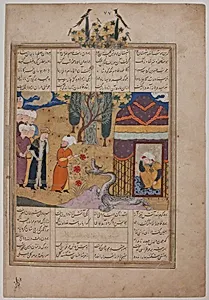
Folio from a Khavarannama (The Book of the East) of ibn Husam al-Din
ca. 1476–86
Medium
Opaque watercolor, silver, and gold on paper
Dimensions
W.11 1/8 in. (28.2cm)
Classification
Codices
Department
Islamic Art
Museum
Metropolitan Museum of Art, New York, NY
Credit
Rogers Fund, 1955
Accession Number
55.125.2
Rights
Public Domain
Tags
Art Historical Context
This folio comes from an illustrated manuscript of the *Khavarannama* (The Book of the East), a Persian epic poem composed by Maulana Muhammad ibn Husam ad-Din in the fifteenth century. The text recounts the heroic exploits of Ali ibn Abi Talib, the cousin and son-in-law of the Prophet Muhammad, blending Islamic history with fantastical adventures. Created around 1476–86, the manuscript reflects the rich tradition of Persian storytelling during the late Timurid period, when epic literature flourished in illustrated codices. The painting employs opaque watercolor, silver, and gold on paper, techniques that allowed artists to achieve luminous effects and intricate details typical of Persian miniature painting. With its vivid depiction of men, women, and dragons, the folio captures the dramatic encounters central to the epic’s narrative, where human heroes confront mythical beasts in vivid, imaginative scenes. Such manuscripts served both as literary treasures and objects of devotion, preserving heroic tales while showcasing the refined artistry of the Islamic world. This example, now in the Metropolitan Museum’s collection, highlights how Persian painters transformed epic poetry into visually compelling works that continue to enchant viewers today.