
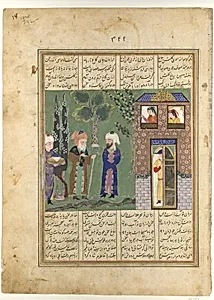
"Three Men Before a Castle", Folio from a Khavarannama (The Book of the East) of ibn Husam al-Din
ca. 1476–86
Medium
Ink, opaque watercolor, and gold on paper
Dimensions
H. 15 11/16 in. (39.8 cm) W. 11 3/8 in. (28.9 cm)
Classification
Codices
Department
Islamic Art
Museum
Metropolitan Museum of Art, New York, NY
Credit
Rogers Fund, 1955
Accession Number
55.184.1
Rights
Public Domain
Tags
Art Historical Context
Behold *Three Men Before a Castle*, a stunning folio from the *Khavarannama (The Book of the East, an epic Persian poem by Maulana Muhammad Ibn Husam-Din. Created around 1476–86, this illuminated page captures a dramatic moment with three figures poised before a majestic fortress, rendered in the refined style of late Timurid manuscript painting. The work hails from the Islamic world, likely a Timurid or Turkman production center like Herat or Shiraz, where such codices blended poetry with vivid visuals to narrate heroic tales of the Prophet Ali's eastern conquests. Artists employed ink for precise outlines, opaque watercolors for rich, jewel-like hues, and gold accents that shimmer against the paper, creating a sense of otherworldly depth in the flat, iconic Persian miniature tradition. Measuring about 16 by 11 inches, this folio exemplifies the codex format—pages from luxurious bound volumes meant for scholarly and royal contemplation, preserving oral epics in tangible splendor. Today, housed in the Metropolitan Museum of Art's Islamic Art Department (acquired via the Rogers Fund in 1955), it offers a window into 15th-century Persia's cultural zenith, where art fused spirituality, history, and storytelling. Visitors can marvel at how these miniatures turned ancient verses into timeless visual poetry.