
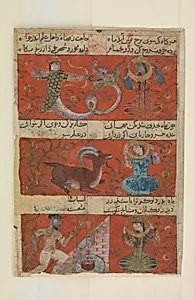
Folio from a Mu'nis al-ahrar fi daqa'iq al-ash'ar (The Free Man's Companion to the Subtleties of Poems) of Jajarmi
dated A.H. 741/1341 CE
Medium
Ink, opaque watercolor, and gold on paper
Dimensions
H. 6 5/8 in. (16.8 cm) W. 9 1/8 in. (23.2 cm)
Classification
Codices
Department
Islamic Art
Museum
Metropolitan Museum of Art, New York, NY
Credit
Cora Timken Burnett Collection of Persian Miniatures and Other Persian Art Objects, Bequest of Cora Timken Burnett, 1956
Accession Number
57.51.25
Rights
Public Domain
Tags
Art Historical Context
This folio comes from a 1341 Persian manuscript titled *Mu'nis al-ahrar fi daqa'iq al-ash'ar* (“The Free Man’s Companion to the Subtleties of Poems”), compiled and copied by the poet Muhammad ibn Badr al-Din Jajarmi. Created during the Ilkhanid period, the work gathers verses by earlier masters and pairs them with delicate illustrations that bring poetic imagery to life. The page exemplifies how 14th-century Persian manuscripts served as both literary treasuries and visual delights for educated readers. Executed in ink, opaque watercolor, and gold on paper, the folio displays the refined techniques of Persian miniature painting: fine brushwork, luminous pigments, and generous use of gold to suggest celestial light. The imagery—featuring the moon, zodiac signs including goats, and wells—likely illustrates verses that link natural and astrological motifs with emotional or mystical themes common in Persian poetry. Preserved in the Metropolitan Museum’s collection, this leaf highlights the rich tradition of integrating word and image in Islamic art. It offers visitors a glimpse into the sophisticated literary culture of medieval Iran, where poetry, science, and beauty were celebrated together on the page.