
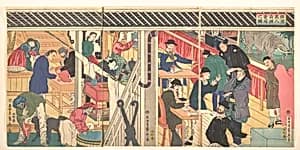
「横浜異人商館買場之圖」|Foreign Business Establishment in Yokohama (Yokohama ijin shōkan uriba no zu)
9th month, 1861
Medium
Triptych of woodblock prints (nishiki-e); ink and color on paper
Dimensions
Image (a): 14 1/2 x 10 in. (36.8 x 25.4 cm) Image (b): 14 1/2 x 10 in. (36.8 x 25.4 cm) Image (c): 14 1/2 x 10 in. (36.8 x 25.4 cm)
Classification
Prints
Culture & Period
Japan · Edo period (1615–1868)
Department
Asian Art
Museum
Metropolitan Museum of Art, New York, NY
Credit
Bequest of William S. Lieberman, 2005
Accession Number
2007.49.130a–c
Rights
Public Domain
Tags
Art Historical Context
This striking triptych by Utagawa Sadahide captures Yokohama’s bustling foreign trading post just seven years after Japan ended its long isolation. Created in the ninth month of 1861, the print shows Western merchants and Japanese visitors mingling amid crates, textiles, and exotic goods inside a spacious warehouse-like structure. The presence of elephants underscores the truly global reach of the newly opened port, where rare animals arrived aboard foreign ships and became objects of fascination for local crowds. Sadahide, a skilled ukiyo-e artist of the late Edo period, specialized in Yokohama-e—colorful scenes documenting the arrival of Westerners and their unfamiliar customs. Printed as a large-format nishiki-e triptych, the work employs vibrant inks and precise linework to convey both the scale of the building and the lively activity within it. The panoramic format lets viewers scan the scene as if standing among the merchants themselves. Today the print offers a vivid window into Japan’s rapid modernization and the curiosity that accompanied the first years of international trade. Its survival in museum collections reminds us how woodblock prints served not only as art but also as popular journalism, shaping public understanding of a world suddenly much larger.
About the Artist
Utagawa (Gountei) Sadahide · 1807–1873
Utagawa Sadahide was born Hashimoto Kenjirō in 1807 in Fusa Province, in the area of modern Chiba Prefecture, Japan. In the 1820s he entered the studio of the enormously prolific and influential master Utagawa Kunisada, becoming one of Kunisada's most prominent pupils and adopting the studio name Sadahide along with the Utagawa school's celebrated lineage. By 1828 his name appeared on a monument l...