
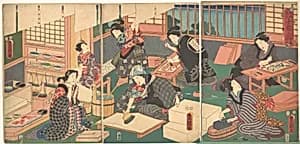
Artisans, from the series "An Up-to-Date Parody of the Four Classes"
19th century
Medium
Triptych of woodblock prints; ink and color on paper
Dimensions
Each 10 x 14 1/2 in. (25.4 x 36.8 cm)
Classification
Prints
Culture & Period
Japan · Edo period (1615–1868)
Department
Asian Art
Museum
Metropolitan Museum of Art, New York, NY
Credit
Gift of Cole J. Younger, 1975
Accession Number
JP3495a–c
Rights
Public Domain
Tags
Art Historical Context
Welcome to the Asian Art galleries, where we spotlight *Artisans*, a vibrant triptych woodblock by Utagawa Kunisada (1786–1864), from his series *"An Up-to-Date Par of the Four Classes"*19th century, Edo period, 1615–1868). This charming work, each panel measuring 10 x 14½ inches, playfully reimagines Japan's traditional social hierarchy—samurai, farmers, artisans, and—through a modern, satirical lens. Kunisada, a master of ukiyo-e ("pictures of the floating world"), captures the everyday vibrancy of urban life with his signature bold colors and dynamic compositions. Printed in ink and color on paper using the collaborative woodblock technique—where artists designed, carvers shaped blocks, and printers applied pigments—this triptych highlights industrious women at work, as suggested by its tags. The medium's affordability made ukiyo-e accessible to commoners, democratizing art during Edo Japan's prosperous merchant culture. Kunisada's exquisite attention to fabrics, expressions, and tools brings these female artisans to life, blending humor with keen social observation. Generously gifted to the Metropolitan Museum of Art in 1975 by Cole J. Younger, this print offers a window into late Edo satire, poking fun at rigid class structures amid growing urbanization. It's a delightful reminder of how art both mirrored and mocked society! (198 words)
About the Artist
Utagawa Kunisada · 1786–1864
**Utagawa Kunisada (1786–1865)** Born in 1786 in the Honjo district of Edo (modern Tokyo), Utagawa Kunisada hailed from a family with a hereditary ferry-boat service that provided financial stability, allowing him to pursue art from a young age. His father, an amateur poet of note, died shortly after his birth, leaving young Sumida Shōgorō (Kunisada's childhood name) to nurture his evident talent...