
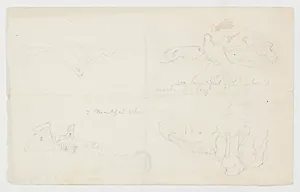
Four Floating Icebergs, Canada
June-July 1859
Medium
seascapes
Classification
seascapes
Department
Smithsonian Collection
Museum
Smithsonian American Art Museum
Credit
Gift of Louis P. Church
Accession Number
1917-4-1196
Rights
Public Domain
About this artwork
Research in Progress
Art Historical Context
Frederic Edwin Church, leading figure of the Hudson River School, the raw majesty of nature in *Four Floating Icebergs,*, painted during his 1859 expedition to Newfoundland and Labrador. In June-July of that year, Church sketched directly from the icy Labrador coast, inspired by dramatic reports of Arctic exploration and the discovery of the abandoned ship *Resolute* embedded in ice. This seascape reflects the era's fascination with polar wilderness, blending scientific curiosity with Romantic awe for untamed landscapes. Church's luminous style, characterized by meticulous detail and glowing light effects, transforms the floating icebergs into ethereal monuments adrift in a vast sea. As a master of luminism—a technique emphasizing atmospheric clarity and divine radiance—he evokes the sublime power of nature, a core tenet of 19th-century American art. The painting's cool palette of blues and whites heightens the sense of isolation and grandeur, inviting viewers to ponder humanity's fragility against elemental forces. Now in the Smithsonian American Art Museum through a gift from Louis P. Church, this work exemplifies Church's role in elevating American landscape painting to international acclaim, bridging art and exploration in an age of expanding frontiers.