
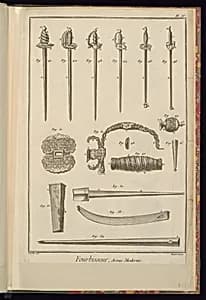
Fourbisseur, Armes Modernes
Classification
Department
Smithsonian Collection
Museum
Smithsonian American Art Museum
Credit
Purchased for the Museum by the Advisory Council
Accession Number
1921-6-344-8
Rights
Public Domain
About this artwork
Research in Progress
Art Historical Context
**Fourbisseur, Armeses** (1762) is an intriguing 18th-century print by French artist J.R.otte (1733–1784), in the Smithsonian American Art's collection. The title, translating to "Swordsmith, Modern Arms," depicts an artisan polishing or finishing contemporary weapons, reflecting the bustling world of French craftsmanship during the Enlightenment era. Prints like this were vital for showcasing trades, serving as both promotional trade cards and educational illustrations that celebrated technical skill amid Europe's military innovations. Lucotte, active in mid-18th-century France, contributed to the era's flourishing print culture, where engraving and etching techniques allowed detailed reproduction of everyday scenes and professions. Though the exact medium remains unidentified amid ongoing research, such works highlight the precision of copperplate methods, capturing textures of metal and tools with remarkable clarity. This piece evokes the pre-Revolutionary fascination with progress, where "modern arms" symbolized advancing metallurgy and warfare technology. Acquired through the museum's Advisory Council purchase, it bridges European artistry with American collections, underscoring the global exchange of ideas. Visitors will appreciate how Lucotte's print immortalizes a vanishing trade, offering a window into the skilled hands behind history's armories. (198 words)