
Franz I. Stephan
um 1760
Medium
Bronze, feuervergoldet
Dimensions
94 cm
Classification
Büste
Department
Belvedere Collection
Museum
Belvedere
Credit
Belvedere, Vienna
Accession Number
4211
Rights
Public Domain
About this artwork
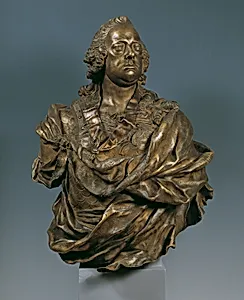
Das Werk ist ein etwas überlebensgroßes Porträt des Kaisers in seinen späteren Jahren. Sein Kopf mit reicher Lockenperücke ist erhoben und leicht nach rechts gewendet. Er trägt einen Schuppenpanzer und darüber um die Schultern einen mit Hermelin gefütterten Brokatmantel der links mit einer juwelenbesetzten Spange zusammengehalten wird. Der Diagonalrichtung des Umhanges folgt ein breites Band am Hals des Monarchen, an dem das Goldene Vließ hing (abgebrochen). Der Büstenabschnitt ist auffallend gr...
Art Historical Context
This striking bronze bust, fire-gilded for a radiant golden sheen, captures Holy Roman Emperor Francis I Stephen in his later years around 1760. Crafted by Austrian sculptor Franz Xaver Messerschmidt, it stands at 94 cm—slightly larger than life—depicting the emperor with a raised head, elaborate curly wig, and a subtle turn to the right. He wears scaled armor beneath an ermine-lined brocade mantle clasped with jewels, symbolizing imperial power; a band at his neck once held the Golden Fleece (now broken). The unusually long bust extends to the waist, its rich drapery artfully concealing traditional arm stumps, blurring the line between bust and half-figure for dynamic effect. Originally displayed in Vienna's imperial armory "Kaisersaal"—a public "temple of fame" for the monarchy and army—the bust was elevated on a marble pedestal inscribed in tribute by Prince Joseph Wenceslaus of Liechtenstein. Flanked by eagles, crowns, regalia like sword and orb, and a trumpeting Fama figure with laurel wreath, it formed part of an opulent Baroque ensemble under a draped baldachin, emphasizing Francis's titles from Germany to Tuscany. Paired with its pendant of Maria Theresa, this popular work embodied Habsburg glory, drawing visitors to the armory as patriotic education. Rediscovered and attributed to Messerschmidt in 1885 by Albert Ilg through stylistic analysis, it exemplifies 18th-century portraiture's blend of realism and regal symbolism in the Belvedere Collection today.
About the Artist
Franz Xaver Messerschmidt · 1736–1783
Comment on works: sculptor