
From "Bizzarie di varie Figure"
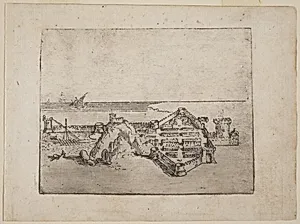
Medium
etching
Dimensions
plate: 8.5 x 10.9 cm (3 3/8 x 4 5/16 in.) sheet: 11.2 x 15 cm (4 7/16 x 5 7/8 in.)
Classification
Department
CG-E
Museum
National Gallery of Art, Washington, D.C.
Credit
Rosenwald Collection
Accession Number
1961.17.42
Rights
Public Domain
Art Historical Context
Giovanni Battista Bracelli'sFrom "Bizzarie varie Figure"* (162) is a captivating etching from a renowned series of 61 prints, showcasing the artist's inventive imagination during the Italian Baroque era. This diminutive work—measuring just 8.5 x 10.9 cm on the plate—depicts whimsical, humanoid figures ingeniously assembled from polyhedra, cylinders, and other geometric forms. Bracelli, a Florentine engraver, transformed mathematical precision into playful surrealism, creating "bizzarie" (bizarre inventions) that blend human anatomy with impossible architecture. Etching, Bracelli's chosen medium, allowed for intricate line work and subtle tonal effects through acid-bitten copper plates, highlighting his technical mastery. Produced amid the Mannerist tradition's lingering influence, these prints reflect a cultural fascination with the grotesque and the fantastical, echoing emblems of the time while anticipating 20th-century optical illusions by artists like M.C. Escher. Housed in the National Gallery of Art's Rosenwald Collection, this piece invites visitors to marvel at early modern experimentation, where art danced on the edge of reality and abstraction, delighting collectors and scholars alike for nearly four centuries.
About the Artist
Giovanni Battista Bracelli · 1590–1690
Giovanni Battista Bracelli was an Italian engraver and draftsman active in Florence in the early seventeenth century. Membership records of Florence's prestigious Accademia del Disegno place him in the institution between 1619 and 1635, providing the primary documentary evidence for his life and career. He studied under the Florentine painter Jacopo da Empoli (1551–1640), whose workshop produced r...