
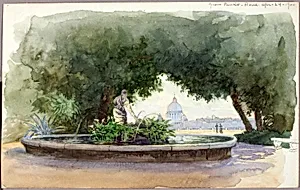
From Pincio, Rome
Medium
Painting
Classification
Painting
Department
Smithsonian Collection
Museum
Smithsonian American Art Museum
Credit
Smithsonian American Art Museum, Bequest of Carolann Smurthwaite in memory of her mother, Caroline Atherton Connell Smurthwaite
Accession Number
1983.83.184
Rights
Public Domain
Tags
Art Historical Context
"From Pincio, Rome" (1900) is a captivating painting by American artist George El Burr, now housed in the Smithsonian American Museum. Captured from the scenic Pincio Hill overlooking the Eternal City, the work highlights iconic Roman elements like stately cypress trees and a fountain, evoking the allure of Italy's landscapes. Created at the turn of the 20th century, it reflects the era's fascination among American artists with European grandeur, as they traveled abroad to study and depict historic sites. Burr, known for his evocative landscapes, skillfully renders this vista in oil on canvas, emphasizing the interplay of light, shadow, and natural forms that define Rome's picturesque terraces. The Pincio, a beloved vantage point since ancient times and popularized in the 19th century for its panoramic views, adds layers of cultural resonance—once a site for Roman spectacles, now a symbol of leisurely elegance. Bequeathed to the Smithsonian in memory of Caroline Atherton Connell Smurthwaite, this piece invites visitors to ponder the bridge between American artistic ambition and classical heritage, offering a serene window into 1900s wanderlust.
About the Artist
George Elbert Burr · 1859–1939
George Elbert Burr was an American printmaker and watercolorist whose career spanned the late nineteenth and early twentieth centuries, earning him a reputation as one of the foremost etchers of the American West. Born in 1859 in Monroe Falls, Ohio, Burr trained as a commercial illustrator before turning his full attention to fine art. He honed his craft through diligent self-study and close obser...