
Furniture Hardware
1820–30
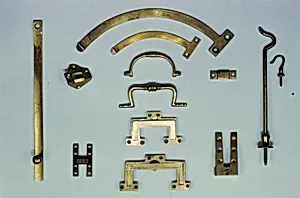
Medium
Gilt brass
Dimensions
H. 1 3/4 in. (4.4 cm)
Classification
Furniture hardware
Department
The American Wing
Museum
Metropolitan Museum of Art, New York, NY
Credit
Gift of Mrs. Edward Hunting Smith, 1968
Accession Number
Inst.68.8.25
Rights
Public Domain
Art Historical Context
Nestled in The American Wing of the Metropolitan Museum of Art, delicate piece of *Furniture Hardware* by Henry Kellam exemplifies the refined craftsmanship of early 19th-century America Crafted between 1820 and 1830 from gilt brass—a luxurious medium where a thin layer of gold is applied over brass for a shimmering, durable finish—it measures just 1 3/4 inches high. Donated in 1968 by Mrs. Edward Hunting Smith, this artifact once adorned high-end furniture, likely as a drawer pull, escutcheon, or knob, elevating everyday objects into symbols of status. Hancock, a skilled metalworker active in Philadelphia, captured the neoclassical elegance popular in the Federal period, blending European influences with American ingenuity. Gilding techniques like electroplating or mercury gilding ensured the brass's golden glow resisted tarnish, showcasing advanced metalworking skills amid the young nation's growing decorative arts scene. Such hardware graced parlors of the emerging middle and upper classes, reflecting a desire for sophistication inspired by ancient Greece and Rome. Today, this unassuming gem highlights how small-scale objects drove artistic innovation, preserving the tactile beauty of America's decorative heritage. Visitors can appreciate its intricate detailing up close, a reminder of the artisans who gilded the nation's domestic life.
About the Artist
Henry Kellam Hancock · 1816–1851
Henry Kellam Hancock (1788–1854) was a prominent American cabinetmaker based in Boston, Massachusetts, where he contributed significantly to the city's early nineteenth-century furniture trade. Son of Captain Belcher Hancock and Ann "Nancy" Susan Ackers, he entered the profession as a chairmaker around 1816 and transitioned to cabinetmaking by 1826, maintaining workshops on Orange Street from abou...