
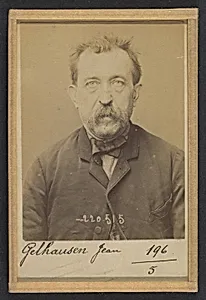
Gelhausen. Jean. 55 ans, né à Grevennemache (Luxembourg). Cordonnier. Infraction à la loi du 18/12/93.
Medium
Albumen silver print from glass negative
Dimensions
10.5 x 7 x 0.5 cm (4 1/8 x 2 3/4 x 3/16 in.) each
Classification
Photographs
Department
Photographs
Museum
Metropolitan Museum of Art, New York, NY
Credit
Gilman Collection, Museum Purchase, 2005
Accession Number
2005.100.375.182
Rights
Public Domain
Tags
Art Historical Context
This poignant albumen silver print from a glass negative captures Jean Gelhausen, a 55-year-old sho (cordonnier) born invenmacher, Luxembourg documented in 1893 for an infraction against the French law of December 18, 1893. Created by Alphonse Bertillon, pioneering French forensic photographer, forms part of a paired portrait—likely full-face and profile views—measuring just 10.5 x 7 cm each. These diminutive images, now in the Metropolitan Museum of Art's Gilman Collection, exemplify Bertillon's revolutionary "anthropometric system," or Bertillonage, which standardized criminal identification through precise photography and body measurements. Bertillon's work marked a transformative moment in late 19th-century criminology, bridging science and visual documentation during the rise of positivist ideas about criminal types. Before fingerprints dominated, his "speaking portraits" (portraits parlés) provided an objective visual record, influencing police practices worldwide and even modern ID photography. Though utilitarian, these prints reveal artistic precision: the sharp detail of albumen silver prints from glass negatives captures subtle facial features and expressions, humanizing subjects amid stark institutional scrutiny. Today, Gelhausen's image invites reflection on privacy, identity, and justice in an era of emerging forensic science, reminding us how photography evolved from art to tool of social control. A fascinating glimpse into history's underbelly!
About the Artist
Alphonse Bertillon · 1853–1914
Alphonse Bertillon (1853–1914) was a pioneering French photographer whose work revolutionized forensic documentation, transforming police identification into a precise visual science. Born in Paris on April 22, 1853, he was the son of medical professor and statistician Louis-Adolphe Bertillon and the younger brother of demographer Jacques Bertillon. Lacking formal higher education after expulsion ...