
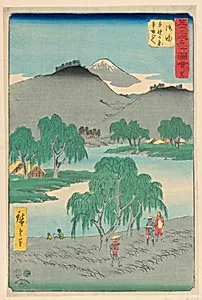
Goyu: Motono-ga-hara and Motozaka Pass (Goyu, Motono-ga-hara Motozaka goe) from the Series 53 Stations of the Tokaido
1797-1858
Classification
landscapes
Department
Smithsonian Collection
Museum
Smithsonian American Art Museum
Credit
Gift of the Estate of Mrs. Robert H. Patterson
Accession Number
1941-31-231
Rights
Public Domain
About this artwork
Research in Progress
Art Historical Context
Ando Hiroshige (1797–1858), a master of Japanese ukiyo-e woodblock, captures the dramatic beauty of travel in *Goyu: Motono-ga-hara and Motozaka Pass from his renowned series *The 53 Stations of the Tōkaidō*. Created during the Edo period (1603–1868), this landscape print depicts scenes from the Goyu station along the historic Tōkaidō road, the vital coastal route connecting Edo (modern Tokyo) to Kyoto. Hiroshige's series, first published around 1833–1834, immortalized the 53 official post stations, blending everyday life with nature's grandeur and becoming one of the most influential works in Japanese art history. The artwork highlights Motono-ga-hara plain and the steep Motozaka Pass, evoking the challenges and wonders of pilgrimage and commerce for travelers in feudal Japan. Hiroshige's style—characterized by vivid colors, atmospheric perspective, and poetic composition—elevates ordinary vistas into timeless poetry, influencing Western artists like Van Gogh and Monet. Though the exact medium remains under research, its classification as a landscape underscores Hiroshige's genius for conveying seasonal light, mist-shrouded mountains, and winding paths that draw viewers into the journey. Housed in the Smithsonian American Art Museum as a gift from the Estate of Mrs. Robert H. Patterson, this print invites us to ponder Japan's rich tradition of visual storytelling, where art bridged urban excitement and rural serenity. A perfect gem for contemplating wanderlust! (198 words)