
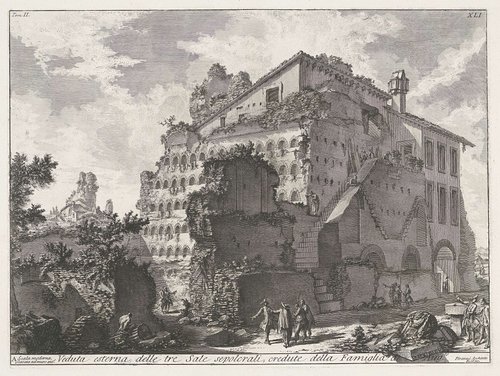
Graftombe van familie van keizer Augustus
ca. 1756 - ca. 1757
Medium
etching
Dimensions
505; 375
Rights
Public Domain
About this artwork
plaatrand: hoogte 375 mm x breedte 505 mm
Art Historical Context
**Graftombe van familie van keizer Augustus** *Giovanni Battista Piranesi, ca. 1756–1757, etching, 375 × 505 mm* Giovanni Battista Piranesi, the visionary 18th-century Italian artist and architect, captures the majestic decay of ancient Rome in this striking etching from his renowned series *Le Antichità Romane di Roma* (Roman Antiquities of Rome). Created around 1756–1757, it depicts the monumental tomb of Emperor Augustus's family—likely the Mausoleum of Augustus, a massive cylindrical structure built in 28 BCE to house the remains of Rome's first emperor and his kin. Piranesi's work reflects the era's fascination with classical antiquity during the Grand Tour, when travelers flocked to Italy to study ruins that symbolized imperial power and eternal legacy. As a master etcher, Piranesi employs meticulous line work to evoke drama and depth, transforming flat copper plates into immersive vistas of crumbling stone and overgrown foliage. His veduta style—topographical views infused with romantic grandeur—elevates archaeological documentation into art, influencing neoclassicism and the Romantic movement. This large-format print (matching the plate's precise 375 × 505 mm dimensions) would have awed collectors, preserving a site now altered by time and urban development. Piranesi's etchings not only record history but stir wonder at Rome's sublime past, inviting us to ponder the fragility of empires amid enduring beauty.
About the Artist
Giovanni Battista Piranesi · 1720–1778
Giovanni Battista Piranesi (1720–1778) was an Italian printmaker, architect, and antiquarian whose visionary etchings of Rome and imaginary prisons revolutionized architectural representation and profoundly influenced both Neoclassicism and Romanticism. Piranesi stands as one of the most important printmakers of the eighteenth century, fundamentally shaping European perceptions of ancient Rome an...