
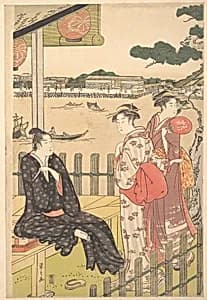
Group at a Tea-house on the Bank of the Sumida River
ca. 1790
Medium
Woodblock print; ink and color on paper
Dimensions
15 1/4 x 10 1/4 in. (38.7 x 26 cm)
Classification
Prints
Culture & Period
Japan · Edo period (1615–1868)
Department
Asian Art
Museum
Metropolitan Museum of Art, New York, NY
Credit
The Howard Mansfield Collection, Purchase, Rogers Fund, 1936
Accession Number
JP2422
Rights
Public Domain
Tags
Art Historical Context
Step into the vibrant world of Edo-period Japan with *Group at a Tea-house on the Bank the Sumida River*, a captivating woodblock print by Chbunsai Eishi, created around 1790. Eishi, a master of ukiyo-e—the "pictures of the floating world"—ized in elegant depictions of beautiful women (bijin-ga), rivaling contemporaries like Utamaro. intimate scene captures a leisurely gathering of men and women at a riverside tea-house along the famed Sumida River in Edo (modern Tokyo), a bustling hub for boating, cherry-blossom viewing, and social outings during Japan's prosperous Edo period (1615–1868). The print's brilliance comes from the woodblock technique, where intricate carvings on multiple blocks allowed for layered ink and color on paper, producing Eishi's signature soft gradations and refined lines. Measuring 15¼ × 10¼ inches, it evokes the transient pleasures of urban life: elegant figures in kimono chatting amid boats gliding by, blending everyday elegance with subtle eroticism. Tea-houses like this were cultural hotspots, offering respite and entertainment for all classes. As part of The Metropolitan Museum of Art's Howard Mansfield Collection, this work exemplifies ukiyo-e's global influence, inspiring later Impressionists with its bold composition and color harmony. A delightful window into 18th-century Japan's refined pleasures! (198 words)
About the Artist
Chōbunsai Eishi · 1756–1829
Japanese, 1756–1829