
Head, Possibly of Empress Flaccilla
Unknown Artist
ca. 380–390
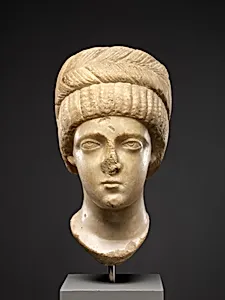
Medium
Marble
Dimensions
Overall: 10 11/16 x 6 1/8 x 6 11/16 in. (27.2 x 15.5 x 17 cm) with base: 11 1/4 in. (28.5 cm)
Classification
Sculpture-Stone
Culture
Byzantine
Department
Medieval Art
Museum
Metropolitan Museum of Art, New York, NY
Credit
Fletcher Fund, 1947
Accession Number
47.100.51
Rights
Public Domain
Tags
Art Historical Context
This exquisite marble head, possibly portraying Empress Flaccilla (ca. 380–390), captures the refined elegance of late Roman portraiture transitioning into Byzantine art. Measuring about 10 11/16 inches tall, it hails from the Eastern Roman Empire, where such sculptures honored imperial figures. Flaccilla, wife of Emperor Theodos I, was renowned for her piety and charitable, making her a symbol of Christian virtue in an era when Christianity was solidifying as the empire's faith. Carved from high-quality marble, the bust exemplifies Byzantine sculptural techniques: intricate drilling for the hair's textured waves, subtle modeling of facial features, and a serene expression conveying imperial dignity. This "possibly" identification underscores the artwork's mystery—its imperial scale and stylized gaze suggest elite patronage, bridging classical realism with the more abstract, spiritual forms of early Medieval art. On view in the Metropolitan Museum of Art's Medieval Art department (Fletcher Fund, 1947), this piece invites visitors to ponder the faces behind Byzantium's golden age, where portraiture served both to immortalize rulers and inspire devotion. A testament to enduring craftsmanship, it whispers of an empress's legacy across centuries.