
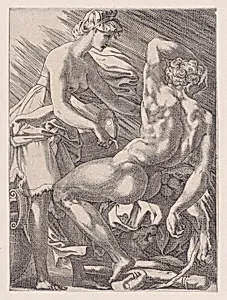
Hercules and Deianira
Medium
Engraving
Dimensions
sheet: 5 7/8 x 4 5/16 in. (15 x 11 cm)
Classification
Prints
Department
Drawings and Prints
Museum
Metropolitan Museum of Art, New York, NY
Credit
Harris Brisbane Dick Fund, 1932
Accession Number
32.92.27(28)
Rights
Public Domain
Art Historical Context
René Boyvin's *Hercules and Deianira is a delicate engraving capturing a pivotal moment from Greek mythology, the hero Hercules receives a fateful gift from his wife Deianira—nowingly poisoned centaur blood that would lead to his tragic end. Created by the 16th-century French engr René Boyvin (c. 1525–1598), a master of the Fontainebleau school, this print exemplifies Mannerist elegance with its intricate lines, elongated figures, and dramatic tension. Boyvin, influenced by Italian artists like Rosso Fiorentino, produced reproductive engravings that popularized courtly tastes across Europe. As an engraving on a modest sheet (5 7/8 x 4 5/16 in.), the work highlights the medium's revolutionary role in the Renaissance: metal plates allowed for multiple impressions, making high art accessible beyond paintings. Boyvin's precise burin work creates rich tonal contrasts and fine details, from flowing drapery to expressive faces, showcasing technical virtuosity. Housed in the Metropolitan Museum of Art's Drawings and Prints department (Harris Brisbane Dick Fund, 1932), it reflects the era's fascination with classical myths, blending heroism and pathos to explore human vulnerability. A gem for print enthusiasts, it invites closer inspection of its narrative depth.
About the Artist
René Boyvin · 1525–1580
French, Angers ca. 1525–1598 or 1625/6 Angers