
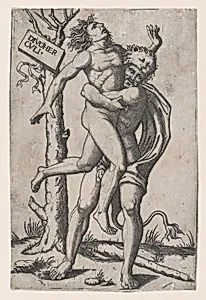
Hercules, grasping Antaeus at the waist with both arms and lifting him off his feet, in background at right the ruins of a temple, at left a group of trees against which are posed a club and the skin of a lion
ca. 1500–50
Medium
Engraving; only state
Dimensions
Sheet: 6 3/4 × 4 7/16 in. (17.2 × 11.3 cm)
Classification
Prints
Department
Drawings and Prints
Museum
Metropolitan Museum of Art, New York, NY
Credit
The Elisha Whittelsey Collection, The Elisha Whittelsey Fund, 1949
Accession Number
49.97.105
Rights
Public Domain
Tags
Art Historical Context
In this dynamic engraving by Marcantonio Raimondi one of the Renaissance's premier printmakers, Hercules triumphs the giant Antaeus in a scene brimming with muscular tension and classical drama. Dated around 1500–1550, the work captures Hercules gripping Antaeus at the waist with both arms, hoisting him skyward to sever his earth-born strength—a clever nod to the myth where the giant drew power from his mother, Gaia. In the background, ruins evoke ancient glory at right, while a cluster of trees at left frames the hero's club and Nemean lion skin, symbols of his legendary labors. Raimondi's mastery of engraving shines in this sole known state, a precise intaglio technique where lines incised into a copper plate hold ink to produce rich, tonal depth on a modest sheet (6 3/4 × 4 7/16 in.). Active in early 16th-century Rome, Raimondi revolutionized printmaking by translating designs from painters like Raphael into affordable, reproducible art, spreading Renaissance ideals of heroism and anatomy across Europe. This piece, from the Metropolitan Museum of Art's Elisha Whittelsey Collection, exemplifies how engravings democratized classical mythology for collectors and scholars. Visitors will appreciate its compact power: a frozen moment of victory amid nature's decay, inviting reflection on human strength versus the earth's enduring mysteries.
About the Artist
Marcantonio Raimondi · 1475–1534
Marcantonio Raimondi (c. 1480–1534), born near Bologna, Italy, emerged as one of the Renaissance's premier engravers, revolutionizing printmaking through his mastery of reproductive techniques. He trained in the workshop of the goldsmith, painter, and niellist Francesco Francia, whose influence is evident in his early engravings, such as the goldsmith-like shading in *Pyramus and Thisbe* (1505), h...