
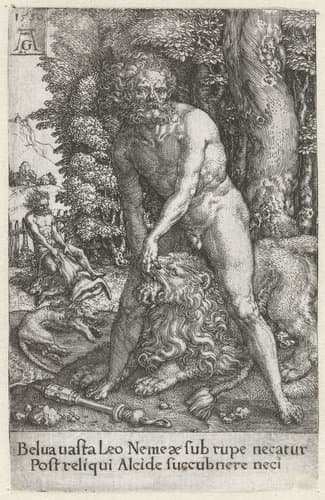
Hercules in gevecht met de Nemeïsche leeuw
Medium
engraving
Dimensions
105; 67
Rights
Public Domain
About this artwork
number: ‘106’
Art Historical Context
In the heart of the Northern Renaissance, Heinrich Aldegver captures one of Hercules' legendary Twelve Labors in *Hercules in gevecht met de Nemeïsche leeuw* (Hercules Fighting the Nemean Lion), an exquisite engraving from 1550 Aldegrever, a German artist from Essen and a member of the esteemed "Little Masters," specialized in intricate small-scale prints like this one, measuring just 105mm high by 67mm wide. The scene depicts the hero wrestling the invincible Nemean lion—whose golden fur repelled weapons—forcing Hercules to strangle it bare-handed, a motif drawn from classical mythology that symbolized human triumph over chaos. Aldegrever's mastery shines in the engraving technique, where a copper plate is incised with fine lines to produce sharp, detailed impressions. This allowed for remarkable precision in rendering muscular tension, fur texture, and dynamic poses within a tiny format, making such works affordable collector's items across Europe. Marked simply with the number "106," it reflects the era's print culture, where engravings disseminated humanist ideals and antique stories to a wide audience. This piece embodies the 16th-century revival of Greco-Roman themes amid religious upheavals, blending pagan heroism with Renaissance virtuosity. A testament to Aldegrever's legacy, it invites viewers to marvel at how a minuscule image packs epic drama.
About the Artist
Heinrich Aldegrever · 1502–1561
Heinrich Aldegrever, born in 1502 in Paderborn, Westphalia, to parents Herman and Katherine Trippenmeker—a family of clog-makers known by the dialect name Trippenmecker—emerged as a multifaceted artist in the German Renaissance. His early training remains undocumented, though he likely apprenticed in a Soest goldsmith's workshop after relocating there around 1525, where he joined the painters' gui...