
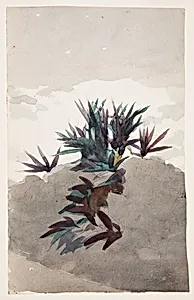
Hillside with Clumps of Maguey
Classification
landscapes
Department
Smithsonian Collection
Museum
Smithsonian American Art Museum
Credit
Gift of Charles Savage Homer, Jr.
Accession Number
1912-12-92
Rights
Public Domain
About this artwork
Research in Progress
Art Historical Context
Winslow Homer, one of America's foremost realist painters (1836–1910), captured the raw beauty of nature in *Hillside with Cl of Maguey* (1898–99). Created during the artist's mature years at his Prouts Neck, Maine studio, this landscape reflects Homer's lifelong fascination with the untamed American wilderness. By the late 1890s, Homer had shifted toward intimate, powerful depictions of land and sea, often emphasizing dramatic light, texture, and solitude—hallmarks of his post-Civil War evolution from illustrator to master painter. The title evokes a rugged hillside dotted with maguey (agave) plants, suggesting an arid or semi-tropical vista that may draw from Homer's travels or studies of exotic flora. Though the medium remains unidentified amid ongoing research, Homer's landscapes from this era frequently employed watercolor or oil to convey atmospheric depth and the elemental forces of nature. Classified within the Smithsonian American Art Museum's landscape collection, it was generously gifted by Charles Savage Homer, Jr., underscoring the artwork's place in the artist's family legacy. This piece exemplifies Homer's artistic significance: his unflinching realism influenced generations, bridging 19th-century Romanticism with modern observation. Visitors can appreciate how it invites contemplation of nature's quiet grandeur, much like Homer's iconic Adirondack or coastal scenes. (198 words)