
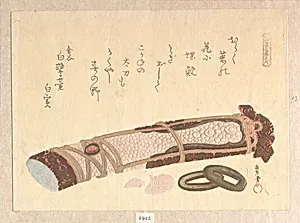
「松風台七番之内柄」|“Hilt of a Sword,” from the series of Seven Prints for the Shōfudai Poetry Circle
1810s
Medium
Woodblock print (surimono); ink and color on paper
Dimensions
5 3/8 x 7 5/16 in. (13.7 x 18.6 cm)
Classification
Prints
Culture & Period
Japan · Edo period (1615–1868)
Department
Asian Art
Museum
Metropolitan Museum of Art, New York, NY
Credit
H. O. Havemeyer Collection, Bequest of Mrs. H. O. Havemeyer, 1929
Accession Number
JP1912
Rights
Public Domain
Tags
Art Historical Context
Nestled in the intimate world of Edo-period Japan (1615–1868), Kubo Shunman’s *“Hilt of a Sword,”* from the series *Seven for the Shōfudai Poetry Circle* (0s), exemplifies the refined art of *surimono*. These commissioned woodblock prints were tokens created for poetry enthusiasts, often featuring embossed textures, metallic pigments, and subtle colors on paper. Shunman, a versatile ukiyo-e artist poet, blended his mastery of ink and color to evoke poetic elegance in this compact 5⅜ × 7½-inch (13.7 × 18.6 cm) gem, now in the Metropolitan Museum of Art’s H. O. Havemeyer Collection. The artwork’s focus on a sword hilt—a motif rich in samurai symbolism—ties into the Shōfudai circle’s haiku or renga gatherings, where images illustrated verses on nature, seasons, or transience. Shunman’s precise lines and delicate shading highlight the hilt’s intricate metalwork, showcasing woodblock printing’s technical prowess: multiple carved blocks layered for vibrant hues and fine details. This medium democratized high art for elite patrons, bridging literature and visual poetry. Such *surimono* offer a window into Japan’s cultured leisure, where art fostered community. Marvel at how Shunman captures quiet power in miniature form, inviting you to ponder the poetry it once accompanied.
About the Artist
Kubo Shunman · 1757–1820
Japanese, 1757–1820