
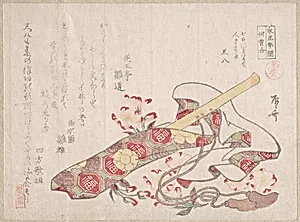
Shakuhachi, (a kind of bamboo flute), with Its Cover and Cherry Flowers
19th century
Medium
Part of an album of woodblock prints (surimono); ink and color on paper
Dimensions
5 1/2 x 7 7/16 in. (14 x 18.9 cm)
Classification
Prints
Culture & Period
Japan · Edo period (1615–1868)
Department
Asian Art
Museum
Metropolitan Museum of Art, New York, NY
Credit
H. O. Havemeyer Collection, Bequest of Mrs. H. O. Havemeyer, 1929
Accession Number
JP2266
Rights
Public Domain
Tags
Art Historical Context
This exquisite woodblock print, titledShakuhachi, (a kind of bamboo flute with Its Cover and Cherry*, was created by Ryūrykyo Shinsai in the 19th century during Japan's Edo period (16151868). Part of a luxurious *surimono*—privately commissioned prints often exchanged among poetry circles—it measures a intimate 5½ × 7⅜ inches and is rendered in vibrant ink and color on paper Shinsai, a of the ukiyo-e tradition, captures the flute's elegant form alongside its protective cover and delicate cherry blossoms, evoking a serene still life that blends everyday objects with poetic beauty. The shakuhachi, an end-blown bamboo flute, holds deep cultural resonance in Japan, particularly linked to Zen Buddhist monks known as *komusō*, who played it for meditation and alms while wandering in basket hats. Cherry flowers, or *sakura*, symbolize the fleeting nature of life, a core theme in Japanese aesthetics celebrated during *hanami* viewing parties. Shinsai's composition reflects Edo-era refinement, where such prints showcased technical virtuosity like subtle gradations (*bokashi*) and fine linework, making art accessible yet elite. Housed in the Metropolitan Museum of Art's Asian Art Department from the H.O. Havemeyer Collection, this piece exemplifies how *surimono* elevated ordinary motifs into profound cultural emblems, inviting viewers to contemplate harmony between music, nature, and transience.
About the Artist
Ryūryūkyo Shinsai · 1799–1823
Ryūryūkyo Shinsai (柳々居辰斎), active from 1799 to 1823, was a prominent Japanese ukiyo-e printmaker based in Edo (modern Tokyo), renowned for his mastery of surimono—luxurious, privately commissioned woodblock prints produced for elite poetry circles and New Year's celebrations. He began his training under Tawaraya Sōri before becoming a student of the legendary Katsushika Hokusai, from whom he recei...