
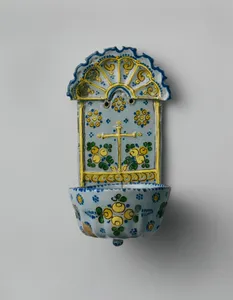
Holy Water Basin
Unknown Artist
ca. 1820
Medium
Tin-glazed earthenware
Dimensions
H. 10 in. (25.4 cm)
Classification
Holy water basin
Culture
Mexican
Department
The American Wing
Museum
Metropolitan Museum of Art, New York, NY
Credit
Gift of Mrs. Robert W. de Forest, 1911
Accession Number
11.87.72
Rights
Public Domain
Tags
Art Historical Context
This charming Holy Water Basin, crafted around 1820 by an unknown Mexican artist, served a vital role in Catholic worship. Standing just 10 inches tall it would have been mounted near church entrances, allowing the faithful to dip their fingers in holy water and make the sign of the cross—a ritual symbolizing purification and protection against evil. Its presence evokes the deep religious devotion of early 19th-century Mexico, time when the nation was newly independent yet steeped in colonial Spanish traditions. Made of tin-glazed earthenware technique known as majolica or talavera—the basin features a glossy, colorful enamel fired over the clay, creating durable, vibrant surfaces ideal for everyday sacred use. Common in Mexican pottery centers like Puebla, this medium allowed artisans to paint intricate motifs, likely including crosses as suggested by its design tags, blending functionality with folk artistry. Housed in the Metropolitan Museum of Art's American Wing and gifted by Mrs. Robert W. de Forest in 1911, this modest yet poignant object highlights the rich interplay of faith, craft, and culture across the Americas, inviting us to appreciate the artistry in humble devotion.