
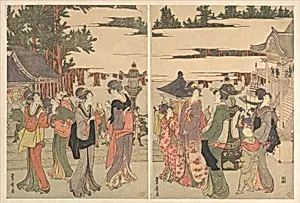
Horinouchi Myo-ho-ji Eho Mairi no Zu
ca. 1804
Medium
Two sheets of a pentaptych of woodblock prints; ink and color on paper
Dimensions
Aiban; H. 13 3/8 in. (34 cm); W. 19 1/2 in. (49.5 cm)
Classification
Prints
Culture & Period
Japan · Edo period (1615–1868)
Department
Asian Art
Museum
Metropolitan Museum of Art, New York, NY
Credit
Gift of Estate of Samuel Isham, 1914
Accession Number
JP1005
Rights
Public Domain
Tags
Art Historical Context
This vibrant woodblock print by Utagawa Toyohiro captures a lively scene at Horinouchi Myo-ho-ji temple during an Eho Mairi procession around 1804. Created during Japan’s Edo period, the work reflects the era’s cultural emphasis on communal festivals and pilgrimages, where townspeople gathered to seek good fortune in the coming year. Toyohiro, a master of the Utagawa school, specialized in such genre scenes that celebrated everyday life and popular customs. The piece forms two sheets of a larger pentaptych, a format that allowed artists to depict expansive crowds and landscapes across multiple panels. Printed with ink and color on paper in the aiban size, it exemplifies ukiyo-e techniques—carved woodblocks inked by hand—that made colorful art accessible to a broad audience beyond the elite. The visible elements of women, boys, houses, and trees suggest a festive gathering filled with movement and community spirit. Today housed in the Metropolitan Museum of Art’s Asian Art collection, this print offers a charming glimpse into early 19th-century Japanese social life and the enduring appeal of woodblock artistry.
About the Artist
Utagawa Toyohiro · 1763–1828
Utagawa Toyohiro (1763–1828) was a Japanese ukiyo-e artist and painter who founded a major branch of the Utagawa school and is best remembered as the teacher of Utagawa Hiroshige, one of the greatest landscape print designers in Japanese art history. Born in Edo (present-day Tokyo), he studied under Utagawa Toyoharu, the founder of the Utagawa school, who was noted for introducing Western perspect...