
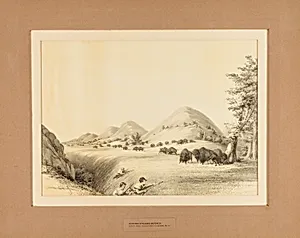
Hunters Stalking Buffalo--no. 11
Medium
Graphic Arts-Print
Classification
Graphic Arts-Print
Department
Smithsonian Collection
Museum
Smithsonian American Art Museum
Credit
Smithsonian American Art Museum, Transfer from the National Museum of Natural History, Department of Ethnology, Smithsonian Institution
Accession Number
1985.66.386,590J
Rights
Public Domain
Tags
Art Historical Context
George Catlin, a pioneering 19th-century American artist, captured the raw drama of Native American life on the Great Plains in *Hunters Stalking Buffalo--no. 11*. This graphic arts print depicts male hunters stealthily pursuing buffalo across a vast landscape, rifle in hand—a tense moment frozen in time. Catlin, who traveled extensively among Indigenous tribes in the 1830s, dedicated his career to documenting their customs and environments before rapid westward expansion threatened their extinction. As part of the Smithsonian American Art Museum's collection, transferred from the National Museum of Natural History's ethnology department, this print highlights Catlin's role in visual anthropology. His works, often reproduced as affordable lithographs, brought authentic scenes of buffalo hunts to Eastern audiences, emphasizing the buffalo's central role in Plains Indian survival for food, clothing, and tools. The introduction of guns in the scene reflects cultural shifts amid European contact. Catlin's realistic style, blending portraiture with landscape, underscores the urgency of cultural preservation. This evocative print invites visitors to reflect on America's vanishing frontier and the artistry born from it.
About the Artist
George Catlin · 1796–1872
George Catlin (1796–1872), born in Wilkes-Barre, Pennsylvania, to Putnam Catlin and Polly Sutton—who had been captured by Native Americans during the 1778 Battle of Wyoming—initially pursued a legal career. Trained at Litchfield Law School, he was admitted to the bar in 1819 but abandoned law after two years to study art in Philadelphia in 1823. Self-taught as a portraitist, Catlin quickly gained ...